How Credit Card Interest Really Works
Learn how credit card interest works, when you're charged interest, how APR is calculated, and practical ways to avoid paying unnecessary interest.
Key takeaway
Learn how credit card interest works, when you're charged interest, how APR is calculated, and practical ways to avoid paying unnecessary interest.
Some links are affiliate links. If you sign up we may earn a commission at no extra cost to you. See our disclosure. This is educational content, not financial advice.
Credit cards let you buy something today and pay for it later. They also come with rewards and fraud protection, and used carefully they help you build a good credit history.
Many people only learn how the interest works when a surprisingly large bill arrives. A common assumption is that the card company charges interest on every purchase. Whether you pay interest actually depends on how and when you repay your balance, and understanding that can save you hundreds, or even thousands, of dollars over time.
This guide covers what APR means, when interest is charged, how it's calculated and how to avoid paying it.
Quick answer
The easiest way to avoid credit card interest is to pay your statement balance in full by the due date every month.
- Interest isn't automatically charged on every purchase.
- If you pay your entire statement balance by the due date, you'll usually avoid interest on new purchases during the grace period.
- If you carry a balance from month to month, interest is generally charged on the unpaid amount according to your card's terms.
- Credit card interest rates are usually expressed as an Annual Percentage Rate (APR).
Credit card terms to know
| Term | Meaning |
|---|---|
| Credit Limit | The maximum amount you can borrow using your credit card. |
| Statement Balance | The total amount shown on your monthly statement. |
| Current Balance | What you currently owe, including recent transactions that may not yet appear on your statement. |
| Due Date | The deadline for making your payment. |
| Minimum Payment | The smallest payment required to keep your account in good standing. |
| Grace Period | The period during which eligible purchases may avoid interest if the statement balance is paid in full. |
| APR | Annual Percentage Rate, the yearly interest rate applied according to your card agreement. |
What is APR?
APR stands for Annual Percentage Rate. It's the yearly cost of borrowing on your card when interest applies.
A card with a 24% APR doesn't charge you 24% on every purchase. The APR is used to calculate interest only on balances that are subject to interest under your card agreement.
Card issuers usually calculate interest daily, using a daily periodic rate derived from the APR. At a 24% APR, that's roughly 24% ÷ 365, or about 0.0658% per day. The issuer then applies that daily rate using its own calculation method.
How the interest builds up
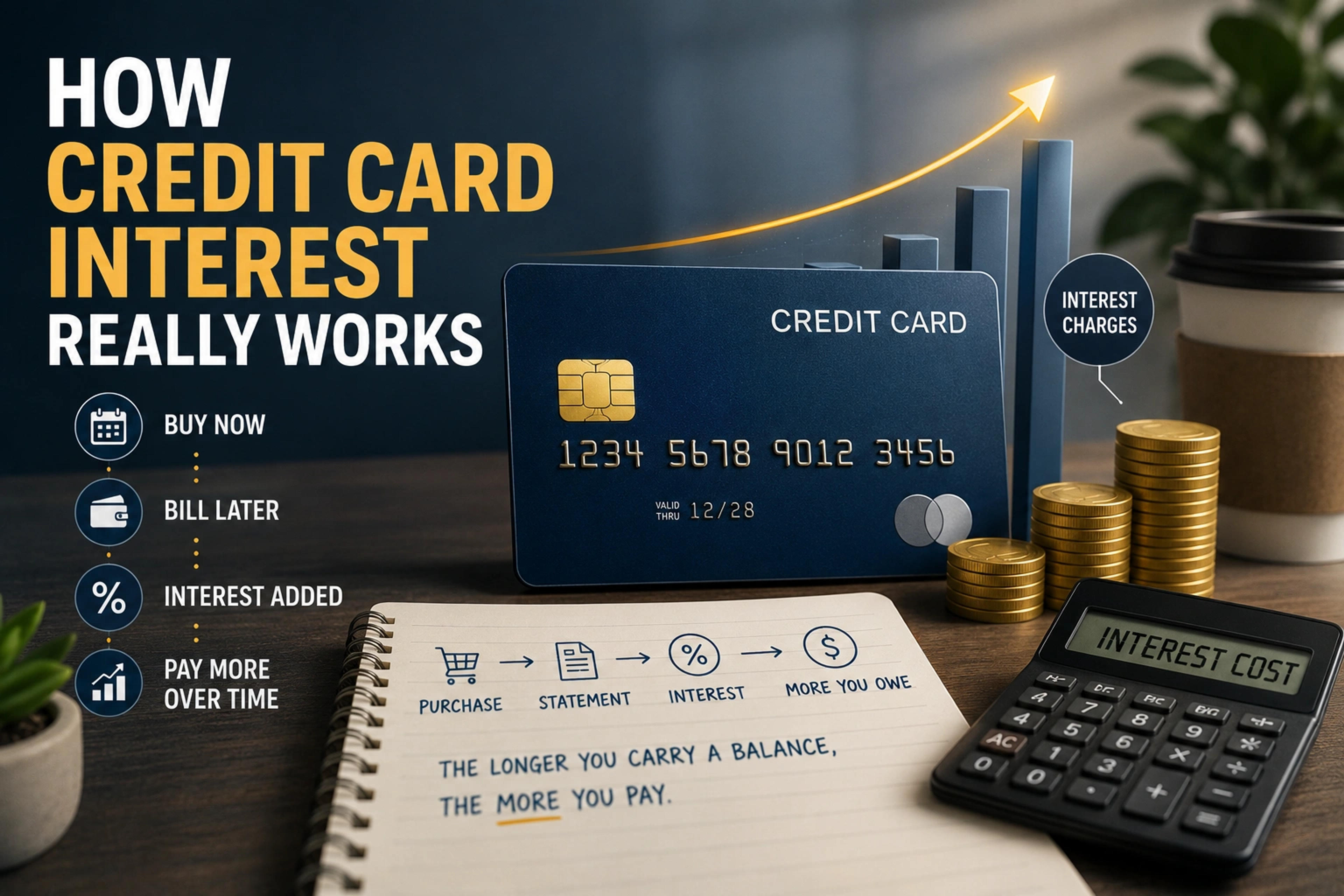
Because interest can accrue every day on eligible balances, it compounds: tomorrow's interest is charged on today's balance plus today's interest. You can see the effect with the calculator below.
See how long it'll take to clear a balance, and the total interest you'll pay.
Payoff timeline
Hover, tap, or use the arrow keys to inspect values for each period.
Time to pay off
2 yr 7 mo
Total interest paid
₹54,995
Total amount paid
₹1,54,995
How this is calculated
Each month, interest accrues on the remaining balance at the monthly rate (APR ÷ 12), and the rest of your payment reduces the principal, the same way card issuers calculate it. Making only the minimum payment shown on a statement is usually far below what this calculator assumes; a fixed, higher payment is what actually clears a balance in a reasonable time.
Your issuer's exact method, such as an average daily balance calculation, is described in your card agreement. The general point holds either way: the longer you carry a balance, the more you end up repaying.
When do you pay interest?
This is where most beginners get confused. There are two common situations.
You pay your statement balance in full
Say your statement shows a balance of $800, due on August 25. If you pay the whole $800 by August 25, you'll generally pay no interest on the new purchases covered by the grace period, as long as your account stays eligible under your card's terms.
You carry a balance
Now say you pay only $300. The remaining $500 carries over under your card agreement, and interest may start accruing on eligible balances. The longer it stays unpaid, the more it costs.
Why paying only the minimum is expensive
Every statement shows a minimum payment. Paying it keeps your account in good standing, but you'll repay the balance much more slowly and may pay far more interest over time.
Take a $2,000 balance at 24% APR with a $50 minimum payment. A large share of each $50 can go to interest rather than reducing what you owe. The exact split depends on your card's terms and payment schedule, but paying more than the minimum cuts your interest costs and shortens the time it takes to clear the balance.
How interest is usually calculated
Every issuer explains its method in the cardholder agreement, but the process generally goes like this:
- Start with your APR.
- Convert the APR into a daily periodic rate.
- Apply the daily rate to the balance subject to interest.
- Keep calculating interest until the balance is repaid under the account terms.
That's why a balance you carry for longer usually costs you more in total.
When interest may apply
Interest may apply when you:
- Carry a balance beyond the grace period.
- Take a cash advance (many cards charge interest on cash advances immediately).
- Make certain balance transfers, depending on promotional offers and terms.
- Miss promotional deadlines or the conditions of introductory financing.
Policies vary between issuers, so check your own card agreement.
How to avoid paying credit card interest
1. Pay your statement balance in full
Doing this each month usually means no interest on eligible new purchases. It's the simplest habit and the one that matters most.
2. Pay before the due date
Late payments can bring extra charges and may hurt your credit history.
3. Avoid carrying a balance
Treat your card as a way to pay rather than a long-term loan wherever you can.
4. Limit cash advances
Cash advances often come with different fees and interest rules from regular purchases.
5. Track your spending
Checking your transactions regularly makes it easier to stay within budget and pay the balance in full.
Common myths about credit card interest
Myth 1: Credit cards always charge interest.
If you pay your statement balance in full and stay within the grace period, you can often avoid interest on eligible purchases.
Myth 2: Paying the minimum avoids interest.
The minimum payment generally keeps you clear of late-payment problems. Interest can still accrue on whatever you leave unpaid.
Myth 3: A higher credit limit means you can spend more.
Your credit limit is the most you can borrow. It isn't a spending target.
Myth 4: Carrying a small balance improves your credit score.
No rule says you have to carry a balance to build credit. Using the card responsibly and paying on time generally matter more.
Key takeaways
- Credit card interest isn't charged automatically on every purchase.
- Paying your statement balance in full by the due date usually avoids interest on eligible purchases.
- APR is the annual rate used to calculate interest when it applies.
- Paying only the minimum can make borrowing much more expensive.
- Knowing your card's terms helps you avoid unnecessary interest charges.
Final thoughts
A credit card only gets expensive when you carry a balance. Used carefully, it's a convenient way to pay, it helps you build a good credit history, and it can come with rewards and consumer protections.
Pay your statement balance in full whenever you can, keep track of what you spend and avoid borrowing you don't need, and you'll get those benefits while keeping interest costs low.
Frequently asked questions
Does every credit card have a grace period?
Many credit cards offer a grace period on eligible purchases if you pay your statement balance in full, but policies vary by issuer.
What happens if I miss my payment?
Depending on your card agreement, you may be charged a late fee, interest may continue to accrue, and repeated late payments can negatively affect your credit history.
Is APR the same as interest?
APR represents the annual interest rate used to calculate borrowing costs under your card agreement.
Should I pay the current balance or the statement balance?
Paying the full statement balance by the due date is generally sufficient to avoid interest on eligible purchases during the grace period. Some people choose to pay the current balance, but this is not always necessary.