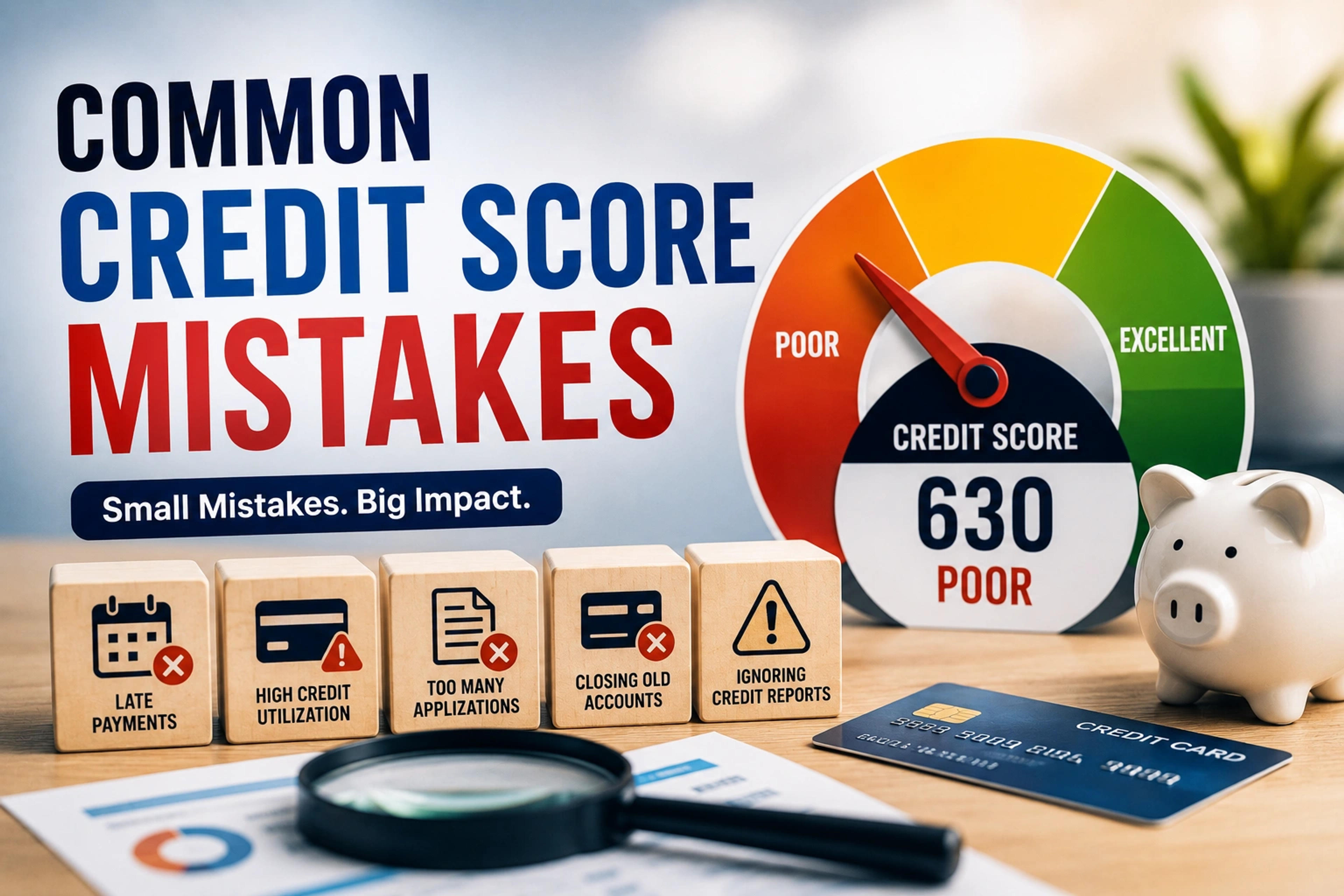
Common Credit Score Mistakes
Learn the most common credit score mistakes, from missed payments and high credit utilization to closing old accounts and applying for too much credit.
Key takeaway
Learn the most common credit score mistakes, from missed payments and high credit utilization to closing old accounts and applying for too much credit.
Some links are affiliate links. If you sign up we may earn a commission at no extra cost to you. See our disclosure. This is educational content, not financial advice.
Your credit score can affect whether you qualify for credit and, depending on the lender and scoring system, the terms you're offered. That makes small mistakes in how you manage credit potentially expensive over time.
Most credit score problems are avoidable, and you don't need complicated strategies or constant monitoring. The fundamentals matter most: pay on time, keep your balances in check, avoid unnecessary applications and check your credit reports for errors.
Here are the most common mistakes to watch for.
1. Paying your bills late
This is one of the most important mistakes to avoid. Payment history is a major part of FICO Scores, making up 35% of the score in the standard FICO model, and even the occasional missed payment can cause problems.
Consider setting up:
- Automatic payments
- Calendar reminders
- Bank alerts
- Payment notifications
If you're worried about overdrawing your account, set reminders and pay manually instead. The aim is never to miss a payment because you forgot the due date.
2. Using too much of your available credit
Your credit limit isn't an amount you should regularly spend. If you have a $10,000 limit and a $7,000 balance, you're using 70% of your available credit, which can be a warning sign to scoring models. Credit utilisation is an important part of the "amounts owed" category in FICO scoring.
You'll often hear about the 30% rule. It's a useful general guide, not a magic threshold that guarantees a particular score. Keep your balances comfortably below your limits where you can, especially if you're about to apply for new credit.
3. Applying for too many credit accounts
A new credit card can be useful. Several new accounts in a short time can cause problems. When you apply, lenders may make hard inquiries, and multiple applications can also leave you with several new accounts. FICO counts recent inquiries and new accounts as part of its new credit factor.
A shop might offer 10% off if you open a store card, but that discount may not be worth another account if you don't actually need the credit. Apply for credit when it serves a financial purpose, not just because there's an offer.
4. Closing an old card without thinking it through
If you have an old card you rarely use, your first instinct may be to close it. Closing an account can reduce your available credit, though, and push up your utilisation if you carry balances on other cards. The CFPB specifically advises people to be careful about closing credit card accounts.
Before closing one, consider:
- How old is it?
- Does it have an annual fee?
- How much total available credit do you have?
- Will closing it cut your available credit significantly?
- Are there better alternatives?
There's no universal rule that you should keep every card open forever. Just don't close accounts on autopilot without thinking about the overall effect.
5. Ignoring your credit report
Your score is calculated from the information in your credit report, so if that information is wrong, your score can suffer. Common errors include:
- Accounts that aren't yours
- Wrong balances
- Wrong credit limits
- Payments wrongly reported as late
- Closed accounts shown as open
- Duplicate accounts
The CFPB recommends checking your reports and disputing inaccurate or incomplete information with both the credit reporting company and the company that supplied it. Check your reports regularly, so you have time to fix problems before you need credit, not on the day you apply for a loan.
6. Watching only the score
Your credit score is useful, but it isn't the whole picture. Two people can have similar scores and very different finances; someone might have a good score while carrying expensive credit card debt. A strong score doesn't mean you're financially healthy, and lenders may look at more than the score when they decide.
Pay attention to:
- Total debt
- Interest rates
- Monthly payments
- Credit utilisation
- Savings
- Income
- Overall cash flow
The goal is healthy credit with your overall finances under control, not just a high number.
7. Carrying a balance to build credit
This is a common misconception. You don't need to pay credit card interest to build a credit history, and carrying a balance from month to month gets expensive, especially on high-interest cards. Use credit responsibly and pay according to your card's terms. Building credit and paying unnecessary interest are different things.
8. Making large purchases without thinking about utilisation
You might use your card responsibly most of the time, then make one large purchase that sends your balance jumping. Even if you plan to pay it off, a high reported balance can affect your utilisation, so the timing of when balances are reported can matter.
Before a big credit card purchase, ask yourself:
- Can I comfortably pay for it?
- How much will it raise my utilisation?
- When is the payment due?
- When might the balance be reported?
Don't spend money you can't afford just to protect your score. Your financial health comes first.
9. Becoming an authorised user without understanding the account
Being added to someone else's credit account can affect your credit profile, depending on the scoring model and how the account is reported. That can help, but it can also hurt if the account has a poor payment history or high balances.
Before becoming an authorised user, find out:
- Whose account it is
- How it's managed
- Whether payments are made on time
- How much of the available credit is being used
Don't assume someone else's credit habits can't affect the information linked to you.
10. Co-signing without understanding the risk
Co-signing a loan is more than a favour. You may become responsible for the debt if the main borrower doesn't pay, and late or missed payments can also affect your credit history depending on how the account is reported. Before you co-sign, ask whether you could afford the payments yourself if the other person stopped paying. If not, think very carefully before agreeing.
11. Ignoring small accounts
People sometimes assume small balances don't matter, but missed payments on small accounts can still end up in your credit history if the account is reported. A forgotten $30 bill isn't harmless just because the amount is small.
Keep a simple list of:
- Credit cards
- Loans
- Payment dates
- Minimum payments
- Account balances
Automation and reminders make this much easier.
12. Closing accounts just because they have no balance
An old, unused account isn't automatically useful, and closing it isn't automatically a good idea either. The right decision depends on the account's fees, your overall credit profile, your utilisation and your goals. That's why generic advice like "always close unused cards" or "never close a credit card" doesn't help much. Your own situation is what matters.
13. Trying to fix your score overnight
There are legitimate ways to improve your credit habits, but no magic shortcuts. The CFPB notes that rebuilding credit takes time and that there are no shortcuts or secrets. Be sceptical of anyone promising to:
- Instantly erase negative information
- Guarantee a specific score
- Create a new credit identity
- Remove accurate negative information
If information is accurate, paying a company won't legally make it disappear. Focus on correcting genuine errors and building a consistent payment history.
14. Taking on debt to improve your credit mix
FICO counts credit mix as one of its scoring categories, but that doesn't mean you should take out a loan you don't need to "improve your mix." Unnecessary debt costs you interest and fees. Don't borrow just for your credit score; use credit when it makes financial sense.
15. Ignoring your credit before a major loan
If you're planning to apply for:
- A mortgage
- Car finance
- A major credit card
- A business loan
don't wait until the day you apply to discover a problem. Check your credit well in advance for:
- Errors
- High balances
- Missed payments
- Accounts you don't recognise
- Outdated information
That gives you time to deal with real issues before you apply.
A simple credit maintenance routine
You don't need to watch your score every day. A simple routine is enough.
Every month, pay on time (set reminders or automate payments), check how much of your credit you're using, and look over any new accounts to make sure nothing unexpected has appeared.
Every so often, review your credit reports for errors or unfamiliar accounts, check that your overall debt is still manageable, and look at unused accounts, weighing their fees and their role in your credit profile before closing anything.
The five habits that matter most
If you remember nothing else, focus on these:
- Pay on time. Payment history is one of the most important factors in FICO scoring.
- Keep your credit use manageable, well away from your limits.
- Apply for credit selectively. Don't open accounts just because you can.
- Check your reports, and dispute anything inaccurate.
- Give it time. A strong credit history comes from consistent behaviour, not tricks.
Final thoughts
A good credit score doesn't come from complicated hacks. It comes mostly from consistent habits: paying your bills on time, not constantly pushing your limits, avoiding unnecessary applications, being careful about closing accounts or co-signing, and checking that the information reported about you is accurate.
Above all, don't let chasing a higher score push you into debt you don't need. A credit score is a tool. The real goal is to use credit responsibly, borrow when it makes sense and build a financial life that gives you more options rather than more debt.