Side Hustle Mistakes Beginners Make
Starting a side hustle? Learn the most common mistakes beginners make, from choosing the wrong idea to underpricing, overspending, and burning out.
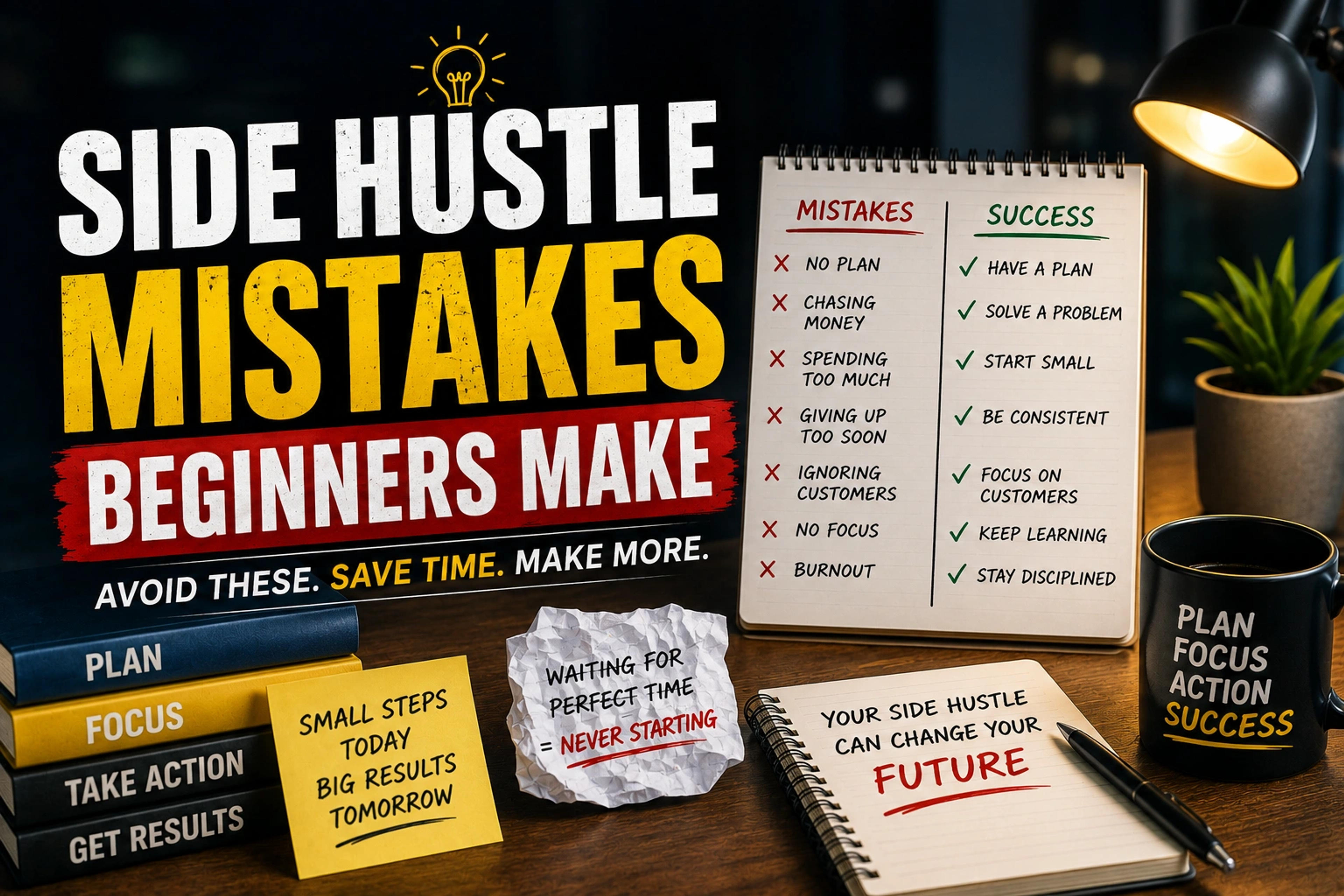
Key takeaway
Starting a side hustle? Learn the most common mistakes beginners make, from choosing the wrong idea to underpricing, overspending, and burning out.
Some links are affiliate links. If you sign up we may earn a commission at no extra cost to you. See our disclosure. This is educational content, not financial advice.
Starting a side hustle sounds simple: find an idea, make something, get customers, earn extra money. In practice, starting is rarely the hardest part. Avoiding the mistakes that waste your time, money and energy is.
Many beginners jump between ideas, spend money before their first sale, undercharge, or pick a business model that doesn't fit their schedule. Some give up because of how they went about it, even though the idea itself was fine. Most of these mistakes are avoidable, and if you're planning a side hustle alongside a job or studies, knowing them can save you months of frustration.
1. Choosing a side hustle because it looks profitable
One of the biggest mistakes is picking an idea because someone online says it makes a lot of money. You see people earning from:
- Dropshipping
- Affiliate marketing
- YouTube
- Freelancing
- Digital products
- Trading
- Print-on-demand
and assume it'll work for you too. A model that works for one person can be completely wrong for another. Look at your skills, the demand in the market and the time you have. If you're already good at video editing, offering editing services probably makes more sense than spending six months learning an unrelated business. The best side hustle is the one you can realistically carry out, not the trendiest one.
2. Starting too many at once
This is very common. A beginner starts a blog on Monday, discovers affiliate marketing on Wednesday, decides to launch a YouTube channel on Friday and starts selling digital products the next week. Now there are four unfinished projects and no real results from any of them.
Every business needs:
- Learning
- Testing
- Marketing
- Customer research
- Improvement
- Consistency
Splitting your attention across several ideas slows all of them down. Pick one main side hustle and give it enough time to see whether there's real demand. If it works, expand. If it doesn't, take what you learned and move on.
3. Spending money before making money
Beginners often think they need to look professional before they can start, so they buy:
- Expensive software
- Premium websites
- Branding packages
- Courses
- Equipment
- Paid advertising
- Business subscriptions
all before finding a single customer. That creates financial pressure you don't need. Ask yourself what the cheapest way is to test whether anyone will pay. If you're offering video editing, you may already have the equipment. If you're selling consulting, you may only need what you know and a way to talk to clients. If you're making digital products, you can usually build a basic version before paying for advanced tools. Prove the demand first and upgrade later.
4. Trying to make everything perfect
Perfectionism can feel like productivity. You spend weeks designing a logo, choosing colours, building a website, setting up social profiles and rewriting your service description, and you still haven't tried to sell anything.
Your first version doesn't need to be perfect; it needs to be useful enough that someone will pay for it. Make it, sell it, get feedback and improve it, rather than polishing it over and over and never launching. Your first customer will teach you things research can't.
5. Not defining a specific customer
Another common mistake is trying to sell to everyone. "I provide digital marketing services for businesses" is very broad. "I create short-form video content for local fitness businesses" is much easier to understand. You know who you're targeting, what you're offering, what problem you solve and where to find potential customers. The more specific you are, the easier it is to start, and you can always widen it later.
6. Focusing on the idea instead of the problem
Beginners often ask what business they should start. A better question is what problem they can solve. People don't pay because you've started a business; they pay because your product or service is worth something to them.
Someone may not really want "website development"; they want more customers from their website. A business may not want "social media management"; it wants consistent content without spending hours making it. Focus on the outcome.
7. Underpricing your work
Many beginners are afraid to charge reasonable prices because they're new. Some flexibility makes sense while you build experience, but being the cheapest option causes problems. If you charge too little, you need too many customers to make the side hustle worthwhile, and that gets exhausting quickly.
Compete on things other than price:
- Quality
- Speed
- Reliability
- Specialisation
- Communication
- Customer experience
You don't want to be the cheapest person available. You want to be someone customers are comfortable paying.
8. Not working out your real profit
Taking in $500 isn't the same as earning $500. Say you make $500 but spend:
- $100 on software
- $75 on advertising
- $50 on supplies
- $50 on transaction fees
Your actual profit is much lower, and you also need to count the time you spent. Track how much money came in, what it cost to deliver, what's left after expenses and how many hours it took. That shows you whether the side hustle is really worth it.
9. Ignoring taxes and legal requirements
Extra income can come with tax obligations, and the rules depend on your country, location, business structure and type of income. Treating side-hustle income as separate from your other financial responsibilities is risky. Keep records of:
- Income
- Business expenses
- Invoices
- Payments
- Receipts
Once your side hustle is bringing in meaningful income, find out which tax and legal requirements apply to you. Don't wait until tax season to discover your records are incomplete.
10. Choosing something that doesn't fit your schedule
A side hustle can sound great until you realise it needs several hours every evening. If you already work full-time, that may not last, and a business that needs you constantly available to customers is hard to run next to a demanding job.
If you only have a few hours a week, consider work you can do on your own schedule, such as:
- Freelance writing
- Digital products
- Graphic design
- Website projects
- Content creation
If you'd prefer flexible physical work, a local service may suit you better. Choose something that fits your actual life, not the free time you imagine you have.
11. Expecting fast results
This is one of the most damaging expectations. A beginner launches something and expects customers in the first week, significant income in the first month and financial freedom by month three. Legitimate businesses rarely work like that. Some service businesses can earn fairly quickly; blogs, YouTube channels, newsletters and digital products can take much longer to build an audience.
Think in stages instead: learn, test, get your first customer, improve, repeat, then scale what works. That's a much healthier mindset than expecting instant results.
12. Quitting before you have enough information
A side hustle doesn't work after two weeks, so you quit. But what did you actually test?
- Did anyone see the offer?
- Did you contact enough potential customers?
- Was the price reasonable?
- Did people understand the offer?
- Was the target audience right?
- Did you improve the product based on feedback?
Sometimes the problem is too little testing rather than a bad idea. Instead of asking whether you made money immediately, ask what you learned from the test, and use that to improve the next version.
13. Spending too much time consuming content
A whole industry exists to teach people how to make money online. You can spend months on YouTube videos, podcasts, courses, tutorials, business documentaries and "day in the life" videos and still have no business. Information helps, but at some point you have to move from learning to doing. For every hour you spend learning, spend more time applying it: build something, contact a customer, publish something, test an offer, get feedback. That's where real experience comes from.
14. Relying too heavily on AI
AI makes many side hustles easier. It can help with:
- Research
- Brainstorming
- Writing
- Design
- Coding
- Video editing
- Automation
It doesn't create value by itself, though. If thousands of people can produce the same generic output with the same tool, that output is hard to stand out with. Rather than "I use AI", your pitch should be that you solve a specific problem and AI helps you do it faster. Your judgment, experience, quality control and understanding of the customer still matter.
15. Depending on one platform
Building your whole side hustle on one platform adds risk. Your business might depend entirely on:
- One social media account
- One marketplace
- One freelance platform
- One advertising channel
- One search engine
If that platform changes its algorithm, fees, policies or account rules, your business feels it. Where it makes sense, build things you control:
- An email list
- Your own website
- Customer relationships
- A portfolio
- Direct ways to contact customers
- More than one way of finding customers
You don't need all of these at once. Just avoid building everything on rented land.
16. Ignoring customer feedback
Beginners sometimes get emotionally attached to their idea and decide people just don't understand the product. Sometimes the opposite is true. If potential customers keep saying it's too expensive, they don't understand what it does, they don't need it or they already have a solution, listen. You don't have to act on every suggestion, but repeated feedback can show you what's wrong with your offer.
17. Not having a simple sales process
A good product doesn't guarantee customers. People need a way to find it, understand it and buy it. If you're freelancing, that might mean:
- Find potential clients.
- Contact them.
- Understand their problem.
- Present your offer.
- Agree on the project.
- Deliver.
- Ask for a testimonial or referral.
Don't make it more complicated than it needs to be.
18. Ignoring repeat customers
Beginners often focus entirely on finding new customers, but a happy existing customer can be worth a lot. Depending on the business, you might offer:
- Monthly services
- Maintenance
- Subscriptions
- Repeat orders
- Additional products
- Upgrades
A website developer could offer ongoing maintenance after building a site, a video editor a monthly editing package and a designer regular social media graphics. Think about what useful service you could provide after the first sale.
19. Letting the side hustle take over your life
Extra money is useful; wrecking your work-life balance to get it may not be. If you're doing your full-time job during the day and your side hustle every evening and weekend, burnout can end up being the biggest cost. Watch for:
- Constant exhaustion
- Poor sleep
- Slipping performance at work
- No personal time
- Losing interest in the business
Set specific working hours, take breaks and keep some time completely free of work. A sustainable side hustle fits into your life without taking it over.
20. Not knowing when to change direction
Persistence is valuable; stubbornness isn't. If you've tested an idea properly and there's little demand, carrying on indefinitely may not help. Changing your target customer, pricing, offer, marketing channel or business model doesn't mean you've failed. It means you're responding to evidence. The goal is to build something people value, not to protect your original idea, so if the plan needs to change, change it.
A better way to start a side hustle
Instead of trying to build a perfect business straight away, work through it in steps:
- Start with a skill you already have.
- Find someone who needs it and the problem they have.
- Create a simple offer with a clear result.
- Find potential customers, starting with your network, local businesses, professional communities or relevant online platforms.
- Get your first sale. Your first goal isn't thousands of dollars; it's proving someone will pay.
- Deliver excellent work and ask for feedback.
- Improve the system: create templates, automate repetitive tasks, refine your pricing and make delivery easier.
- Scale carefully, adding spending or complexity only once you've proven the business works.
A beginner side-hustle checklist
Before you start, ask yourself about the business:
- What problem am I solving?
- Who has this problem?
- Why would they pay me?
- What makes my offer useful?
About money:
- How much will it cost to start?
- What expenses do I expect?
- What's my potential profit?
- Do I understand my tax obligations?
About time:
- How many hours can I realistically commit?
- Can I keep this schedule up for six months?
- What happens when my main job gets busy?
And about growth:
- Can I get repeat customers?
- Can I raise my prices as I improve?
- Can I automate repetitive work?
- Could this eventually become a bigger business or asset?
If you can answer these clearly, you're already ahead of many beginners.
The most important lesson
You'll make some mistakes, and that's part of building a business. What you want to avoid are the expensive ones that could have been prevented. Don't spend thousands before confirming demand, don't work seven days a week without a plan, don't assume revenue equals profit, don't chase every new trend and don't build around unrealistic income promises. Start small, test quickly, listen to customers, track the numbers and improve what works.
Key takeaways
- Don't choose a side hustle just because it looks profitable.
- Start with one idea instead of juggling several projects.
- Confirm demand before spending heavily.
- Don't mistake preparation for progress.
- Choose a specific customer and problem.
- Price your work on value, costs and time, not fear.
- Track profit, not just revenue.
- Understand the taxes and other requirements that apply to you.
- Choose a business model that fits your schedule.
- Don't expect every side hustle to pay off immediately.
- Use AI as a productivity tool, not as your whole advantage.
- Build customer relationships and don't depend on one platform.
- Protect your time and avoid burnout.
- Be willing to change direction when the evidence says so.
Final thoughts
A side hustle can raise your income, build useful skills and eventually become something of your own, and it doesn't have to be complicated. You don't need the perfect idea, expensive equipment, thousands of followers or the latest get-rich-quick strategy. Start with something you understand, find a real problem, make a simple solution, try to sell it and use what you learn to improve.
Your first side hustle may not become your long-term business, and that's fine. The skills you build along the way can be worth as much as the money. What gives beginners an edge isn't knowing everything; it's being willing to start small, learn quickly and not repeat the same expensive mistakes.