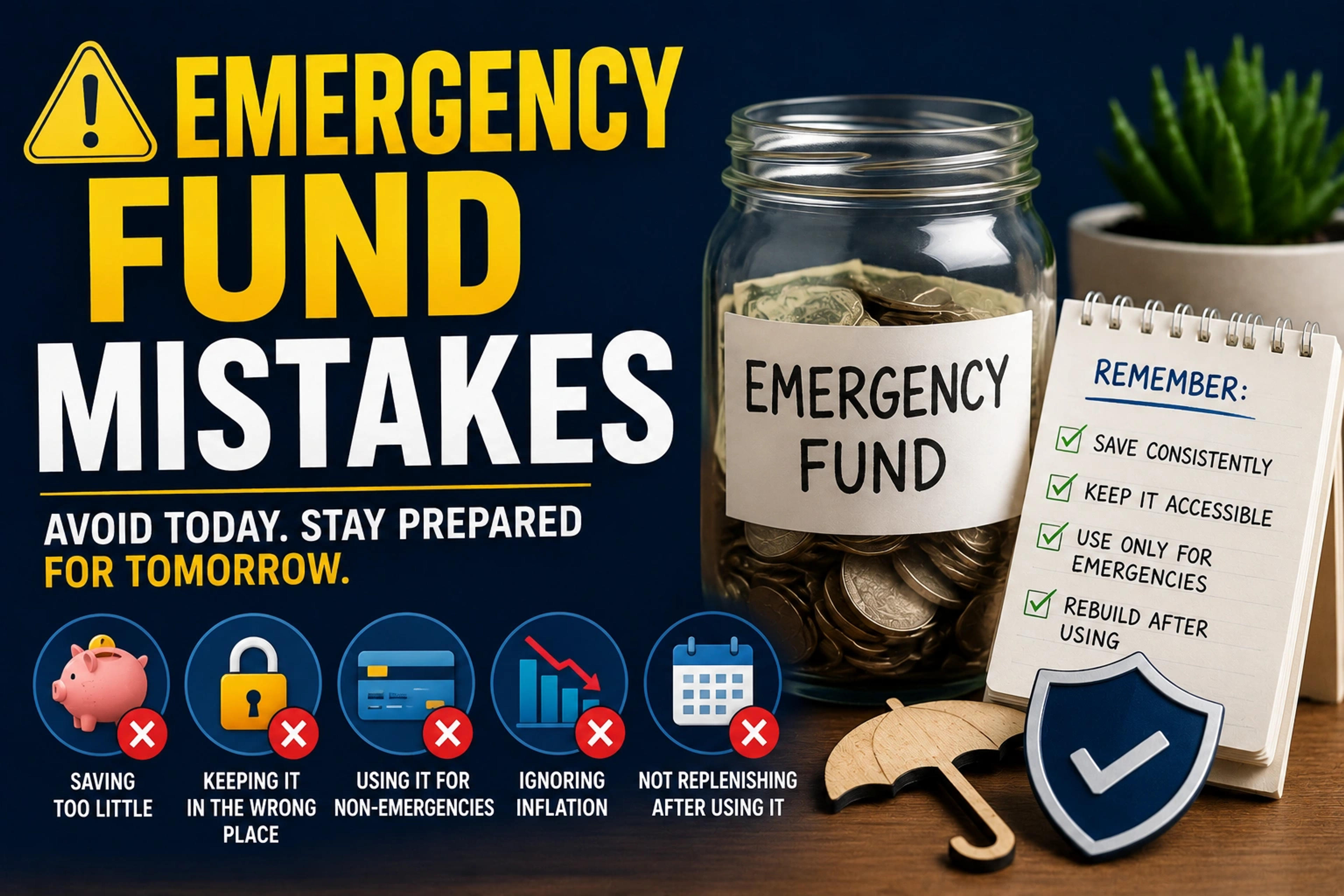
Emergency Fund Mistakes
Learn the most common emergency fund mistakes, including saving too little, keeping it in the wrong place, and using it for non-emergencies.
Key takeaway
Learn the most common emergency fund mistakes, including saving too little, keeping it in the wrong place, and using it for non-emergencies.
Some links are affiliate links. If you sign up we may earn a commission at no extra cost to you. See our disclosure. This is educational content, not financial advice.
An emergency fund sounds simple: put money aside for unexpected expenses. Having money in a separate account doesn't guarantee it'll work when you need it, though. You can save for years and still find your fund falls short, usually because of how it was built, where it's kept or how it's been used.
Here are the most common mistakes to avoid.
1. Picking a random savings target
A common approach is to pick a round number, say ₹1 lakh, and call it done. The right size depends on your actual expenses: someone spending ₹25,000 a month needs a very different safety net from someone spending ₹80,000.
Start by working out your essential monthly expenses instead. Include things like:
- Housing
- Food
- Utilities
- Insurance
- Transportation
- Essential debt payments
- Necessary medical or household costs
Then use that figure to decide how much protection you need.
2. Basing it on income instead of expenses
Your salary doesn't decide how big your emergency fund should be; your essential expenses do. Two people might both earn ₹70,000 a month, but one needs ₹35,000 to cover essentials and the other needs ₹55,000. Their funds shouldn't necessarily be the same size. Build yours around what you need to keep going, not what you earn.
3. Making the money too hard to get
An emergency fund isn't an investment portfolio. If your car needs an expensive repair or you lose your income, you may need the money quickly, and savings that take days to reach add stress you don't need. Look for somewhere that balances safety, easy access and a reasonable rate of interest. The right account or product depends on your country and circumstances.
4. Taking too much investment risk
An emergency fund does a different job from your long-term investments. You don't want to find your savings have dropped sharply in value at the exact moment you need them. Its purpose is stability and easy access, not the highest possible return. Your long-term investments can take more risk because you won't need that money for years.
5. Keeping it in your everyday account
If your emergency money sits in the same account you use for shopping, food, entertainment, bills and everyday spending, it's much easier to spend by accident. A separate account draws a line: you can see the money without treating it as spending cash.
6. Using it for predictable expenses
An emergency fund shouldn't turn into a general savings pot. Annual insurance premiums, planned holidays, gifts and routine car maintenance aren't emergencies. If you know an expense is coming, set up a separate sinking fund for it: an emergency fund for unexpected problems, a travel fund for planned trips, a car fund for expected maintenance. That keeps your emergency money free for real surprises.
7. Making the fund too small
A small emergency fund is still much better than none, but don't assume ₹10,000 or ₹20,000 will cover every problem. A starter fund helps with minor emergencies, and you can build toward a larger reserve over time. People with unstable income or big financial responsibilities may need a bigger cushion than someone with a predictable income and low essential costs.
8. Stopping once you hit your first target
Your circumstances change. You might:
- Move to a more expensive home
- Take on new debt
- Have children
- Change jobs
- Become self-employed
- Lose another source of household income
When your essential expenses go up, review your emergency fund too. Your old target may no longer give you the same protection.
9. Ignoring insurance
Your emergency fund can't handle every disaster on its own. Insurance protects against large losses that would wipe out your savings. Depending on your situation, that could include appropriate:
- Health insurance
- Vehicle insurance
- Home or renters insurance
- Life insurance where relevant
The emergency fund handles shocks you can manage; insurance protects you from much bigger losses. You need both.
10. Treating a credit card as your emergency fund
A credit card gives you short-term access to money, but it isn't the same as having savings. If you can't repay the balance quickly, interest turns an unexpected expense into expensive debt. A ₹30,000 emergency paid from savings costs ₹30,000. The same emergency on a high-interest card can cost a lot more if you carry the balance.
11. Forgetting about inflation
Your emergency fund doesn't need to chase investment returns, but money loses buying power over time. If your essential expenses rise a lot, a fund that looked big enough a few years ago may not protect you the same way now. Review the target every so often rather than treating the original number as fixed.
12. Waiting for the perfect time to start
Putting it off again and again is one of the most damaging mistakes. You don't need to build the whole reserve at once. Start with whatever fits your budget today and automate regular contributions, growing from ₹2,000 to ₹5,000 to ₹10,000 and beyond. Having a system you can repeat matters more than the exact amount.
What actually counts as an emergency?
Before you take money from the fund, ask three questions.
Is it unexpected? If you knew about it months ago, it probably belongs in another savings pot.
Is it necessary? A sale on a new phone isn't an emergency just because the discount ends tomorrow.
Is it big enough to matter? If you can comfortably cover a small expense from your normal budget, it may not be worth touching your reserve.
A useful test is whether the expense would seriously disrupt your finances if you had no savings. If it would, your emergency fund is doing exactly what it's for.
What to do after using it
Using the fund isn't a failure; that's what the money is for. The mistake is using it and then forgetting to rebuild it. Say your fund was ₹2,00,000 and you spent ₹50,000 on an unexpected expense, leaving ₹1,50,000. Once the immediate problem is dealt with, make topping it back up a priority.
A simple emergency fund system
- Work out your essential expenses from your actual spending rather than guessing.
- Set a realistic first target. Start with a smaller milestone if the full reserve will take a while.
- Keep the money accessible so it's there when you really need it.
- Keep it separate from your spending money, so you don't spend it by accident.
- Review it every so often and adjust the target when your expenses or circumstances change.
- Rebuild it after you use it, and treat that as a priority.
Final thoughts
An emergency fund won't make you rich. Its job is to stop a bad event from turning into a financial crisis.
The biggest mistakes usually aren't about saving too little. They're about building the wrong kind of reserve: one that's hard to reach, too easy to spend, invested too aggressively or constantly raided for predictable costs. Build your fund around your real life, keep it accessible and give it a clear purpose. When life forces you to use it, don't feel guilty. Just rebuild it.