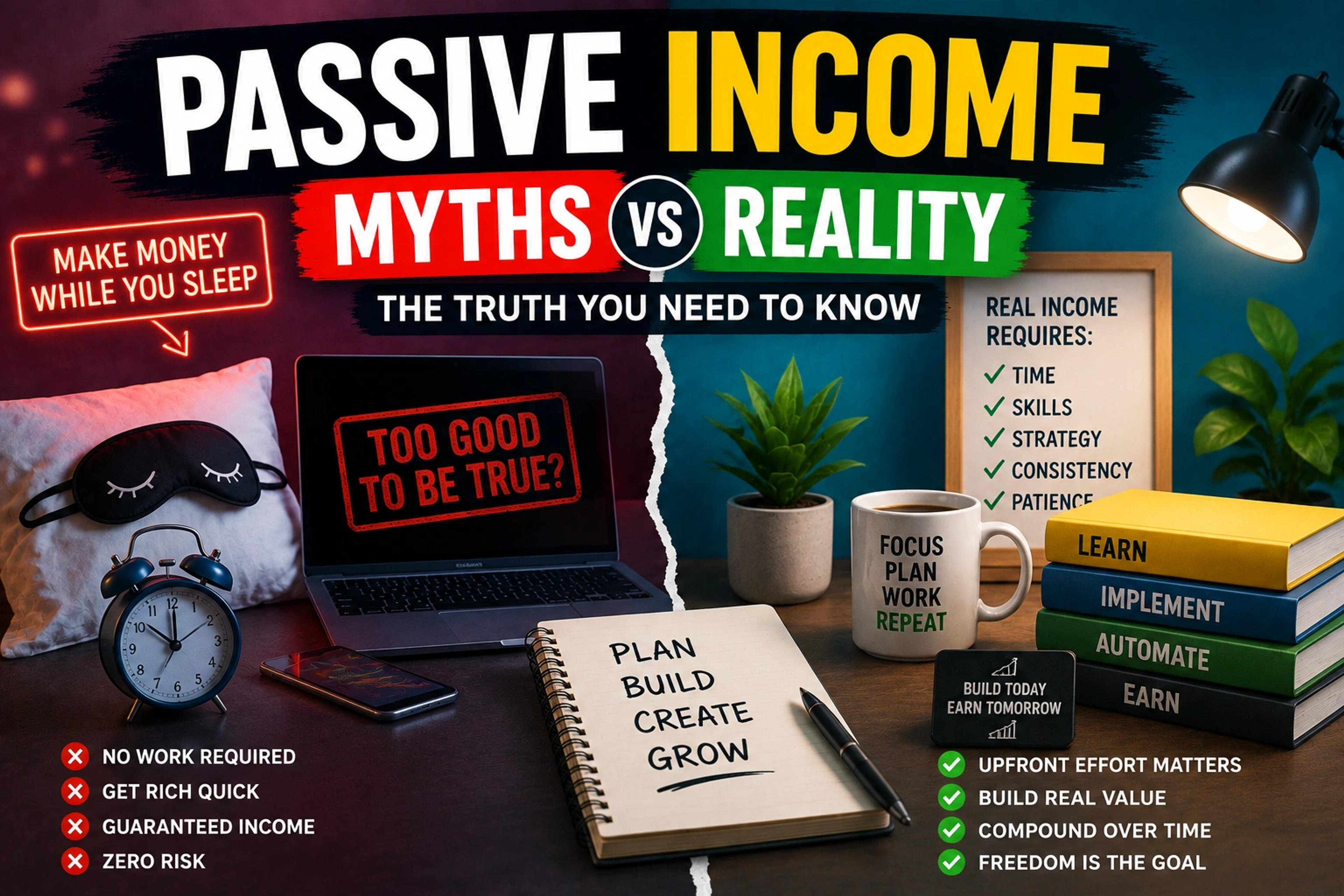
Passive Income Myths
Passive income sounds effortless, but many popular claims are misleading. Learn the biggest passive income myths and what it really takes to build income-producing assets.
Key takeaway
Passive income sounds effortless, but many popular claims are misleading. Learn the biggest passive income myths and what it really takes to build income-producing assets.
Some links are affiliate links. If you sign up we may earn a commission at no extra cost to you. See our disclosure. This is educational content, not financial advice.
"Make money while you sleep" is one of the most appealing promises on the internet. You make something once, automate a few things and supposedly watch the money arrive without doing any more work.
There's some truth to it. A digital product can keep selling after you make it, investments can produce income without daily work, and a useful website can keep attracting visitors months after an article goes up. What the internet tends to leave out is that passive doesn't mean effortless. Knowing the difference can save you from wasting money on courses, chasing unrealistic opportunities or expecting a new side hustle to replace your salary overnight.
Here are the biggest passive income myths, and what actually makes sense.
Myth 1: Passive income means no work
This is the biggest misconception. Most passive income takes a lot of work upfront. Before a digital product makes its first sale, for example, you may need to:
- Research the market
- Create the product
- Design it
- Build a sales page
- Find customers
- Handle support
- Update the product
The same goes for blogs, YouTube channels, courses, software and many other online businesses. Passive income is better understood as income that can continue with relatively little direct effort once the initial work is done. The work doesn't disappear; it changes.
Myth 2: You can build passive income in a weekend
You can start building a passive income asset in a weekend. You probably can't build a reliable income stream that fast. A weekend might produce your first template, ebook, video, website, digital product or investment plan, but making the asset is only the beginning. People still have to find it, trust it and decide to pay for it. A weekend can give you momentum; it shouldn't give you unrealistic expectations.
Myth 3: Passive income is risk-free
This myth can get expensive. Every investment carries some risk, and the SEC specifically warns investors to be suspicious of opportunities promising high returns with little or no risk.
Businesses are no different. A digital product might not sell, a website might never get enough traffic, a rental property can sit empty or need expensive repairs, and a software product can lose customers. Passive doesn't mean safe. If someone promises unusually high returns with almost no risk, slow down and investigate before you put money in.
Myth 4: You need a huge audience
You don't need millions of followers. You need the right people. Picture 100,000 followers who don't care about what you sell, then picture 5,000 followers who all have the problem your product solves. The smaller audience may be worth far more, which is why niche businesses can work.
Myth 5: You need lots of money to start
Some passive income models need a lot of capital; others don't. You can start building some assets with little money, including:
- Digital products
- Templates
- Content websites
- Newsletters
- Online courses
- Educational resources
There's a trade-off, though. Spending less money usually means spending more time. If you don't have much capital, you'll probably need to put in more of your own time and skills. There's almost always a cost somewhere.
Myth 6: AI has made passive income automatic
AI has made many tasks faster. It can help with:
- Research
- Writing
- Coding
- Design
- Video production
- Automation
But AI doesn't create demand. You can generate hundreds of articles or designs in no time and still make nothing, because making something isn't the same as making something people want. The advantage comes from combining AI with your own skill, judgment and ideas, aimed at a real customer problem. Use AI to work more efficiently, not as a substitute for value.
Myth 7: Dividend income is free money
Dividends can provide investment income, but calling them free money is misleading. A dividend is a payment from a company to its shareholders, and what matters is the investment's overall performance, including income, price changes, costs, taxes and risk.
A high dividend yield isn't automatically good. A company's yield can be high because its share price has fallen, or because the dividend may be hard to keep paying. So besides asking how much dividend you'll receive, ask what you're paying for the investment, what risks you're taking and what total return you can expect.
Myth 8: Rental income is completely passive
Property is often sold as the ultimate passive income machine, but owning a rental can involve:
- Finding tenants
- Repairs
- Maintenance
- Insurance
- Taxes
- Empty periods
- Financing
- Legal responsibilities
You can hire a property manager to take on some of the work, but that's another cost. Rental property can become more passive; it doesn't become effortless.
Myth 9: You can quit your job as soon as you make some money
Making your first $100 online is exciting. Making $100 consistently means a lot more, and making enough to reliably cover your living costs is another level entirely. One good month doesn't prove an income stream will last. Before you depend on a new source of income, ask:
- How consistent is the revenue?
- What are the expenses?
- How much work does it take?
- Could the revenue suddenly disappear?
- Do you have an emergency fund?
- Is demand stable?
Don't swap reliable income for an unproven income stream just because it looks promising.
Myth 10: Passive income doesn't need marketing
This is where many good products fail. You can make an excellent course, ebook, template, website or software tool, and if nobody knows it exists, it won't earn much. You still need distribution, which could come from:
- Search engines
- Social media
- YouTube
- Partnerships
- Communities
- Referrals
- Paid advertising
Build the asset, and build a way for people to find it.
Myth 11: You need several income streams straight away
You don't. Trying to build five income streams at once can leave you with five unfinished projects. It works better to build one, get it working, improve it and automate it, and only then diversify.
You might start with a digital product, for example. Once it sells consistently, you could add:
- A related product
- An email newsletter
- Affiliate income
- A membership
- Another product that complements the first
Build a foundation before you add complexity.
Myth 12: Passive income and "passive activity" are the same thing
This distinction matters if you're thinking about taxes. In everyday language, "passive income" means money that takes little ongoing work. US tax law uses "passive activity" as a technical term. The IRS generally describes passive activities as trades or businesses you don't materially participate in, along with certain rental activities, and portfolio income such as interest and dividends is treated separately from passive activity income under those rules.
So don't assume that something sold as passive income gets any particular tax treatment. Tax rules depend on the type of income and your circumstances.
What passive income really looks like
A more realistic picture goes like this:
- Put in time, money or skills.
- Build an asset.
- Make it valuable.
- Find an audience.
- Earn revenue.
- Automate and improve it.
- Reduce the ongoing effort.
Many online success stories skip the early steps. The income may eventually become fairly passive, but someone had to build the machine first.
Five more realistic passive income models
If you want to explore passive income seriously, these are worth researching:
- Digital products. Templates, guides, spreadsheets and other downloads can be sold again and again.
- Content assets. Evergreen articles and videos can keep attracting visitors after you publish them.
- Online courses. A well-made course can be sold repeatedly, though it may need updates and customer support.
- Software. A useful software product can bring in recurring revenue, but maintenance and support still matter.
- Investments. Interest, dividends and capital growth can produce investment income, although returns are never guaranteed and investments carry risk.
The IRS recognises several forms of investment income, including interest, dividends, rents, royalties and certain gains, but how they're taxed varies from case to case.
A better question to ask
Instead of asking how to make money without working, ask what you could build once that would keep creating value. That might be:
- A useful piece of software
- A collection of educational content
- A digital product
- A portfolio of investments
- A course
- A website
- A licensing library
That moves you from chasing easy money to building assets.
A simple rule for spotting bad opportunities
Be extremely cautious when you see all three of these together:
- High returns: "Make 20% every month."
- Little work: "You don't need any experience."
- Little risk: "Your money is completely safe."
That combination should raise questions straight away. The SEC specifically warns that promises of high guaranteed returns with little or no risk are classic signs of fraud. Real opportunities can be attractive; they don't need to sound magical.
Final thoughts
Passive income is real. The fantasy around it isn't. There are legitimate ways to build income that depends less on your daily work, but almost all of them need something first: money, time, skills, effort or patience.
The people who end up with useful passive income streams usually aren't the ones hunting for the easiest shortcut. They're the ones willing to build something valuable and let it grow. Ask yourself what valuable asset you could start building today. The results may come more slowly, but they'll be far more realistic.