Passive Income Ideas You Can Build on Weekends
Discover practical passive income ideas you can build on weekends, from digital products and affiliate content to blogs, templates, and online assets.
Key takeaway
Discover practical passive income ideas you can build on weekends, from digital products and affiliate content to blogs, templates, and online assets.
Some links are affiliate links. If you sign up we may earn a commission at no extra cost to you. See our disclosure. This is educational content, not financial advice.
Passive income appeals for an obvious reason: you want your money to keep working when you aren't. What often gets left out is that most passive income isn't passive at the start. You usually have to make a product, build an audience, set up a system or invest money before any income arrives. The passive part comes later, when something you've already built keeps earning with relatively little ongoing work.
That's what makes weekends useful. You don't need to quit your job or spend every evening on a business; a few focused hours each weekend can go into something that earns repeatedly. This guide covers realistic passive income models you can build gradually, not promises of thousands of dollars overnight.
Quick answer
Don't ask how you can make passive income this weekend. Ask what useful asset you can start building this weekend.
A passive income asset generally has three features: you create or acquire something valuable, people can buy or use it without you being involved every time, and it keeps earning after the initial work. A digital template sold over and over, or an article that keeps earning affiliate commissions, are good examples.
Most passive income businesses still need occasional maintenance, customer support, marketing or updates, so think of it as low-maintenance income rather than effortless income.
1. Digital templates
Low startup cost, beginner to intermediate difficulty, and one or a few weekends to build. Digital templates are one of the most practical things to make when your time is limited. Examples include:
- Budget spreadsheets
- Resume templates
- Business proposal templates
- Content calendars
- Notion dashboards
- Invoice templates
- Social media planning templates
- Study planners
Solve a specific problem. A generic planner faces enormous competition, while a project management template for freelancers or a monthly budget template for college students has a much clearer audience.
Spend Saturday researching the problem and making the first version, and Sunday improving the design, testing it, writing instructions and preparing the listing. Once it's published, you can sell it again and again without remaking it for each customer.
2. A niche blog
Low to moderate startup cost, intermediate difficulty, and several months to build. A blog isn't passive at first: you have to research topics, write useful content, optimise pages and build traffic. Articles that do well, though, can keep attracting visitors long after you publish them. A niche blog can eventually earn through:
- Affiliate marketing
- Display advertising
- Digital products
- Sponsorships
- Lead generation
Don't start a blog about everything. Pick a specific topic you can keep writing useful content about, such as personal finance, software tutorials, home improvement, career development, technology or education. A blog is a long-term asset, not a way to make money this weekend.
3. An affiliate content website
Low startup cost and intermediate difficulty. Affiliate marketing lets you earn a commission when someone buys a product or service through your referral. You can build an affiliate business with:
- Blog articles
- Comparison guides
- Tutorials
- YouTube videos
- Newsletters
- Social media content
Instead of an article called "Best Products", write something actually useful, like "How to Choose a Laptop for Video Editing", and recommend suitable products within the guide. A useful article can keep pulling in search traffic and earning commissions after you've published it, but it'll need occasional updates as prices, products and availability change.
4. A short ebook
Low startup cost and intermediate difficulty. You don't need a 300-page book. A focused ebook that solves one problem can be more useful than a huge one that covers everything, for example:
- A beginner's budgeting guide
- A freelancing starter guide
- An interview preparation guide
- A beginner photography handbook
- A social media guide for small businesses
What matters is original, useful information, not a large amount of AI-generated text. AI can help with outlining, editing and research, but the final product needs to be accurate and genuinely helpful.
5. A print-on-demand store
Low startup cost and intermediate difficulty. Print-on-demand lets you sell products without holding stock. Depending on the platform and supplier, you could sell:
- T-shirts
- Posters
- Mugs
- Tote bags
- Notebooks
When a customer orders, the fulfilment provider makes and ships the product. Setting up the store is fairly easy; getting customers is the hard part. Uploading hundreds of random designs won't create passive income. Pick a specific audience and make designs that appeal to them.
6. Stock photos, videos or illustrations
The startup cost depends on your equipment, and the difficulty is beginner to intermediate. If you already enjoy photography, video, illustration or graphic design, you can turn your work into a reusable library. Subjects that sell commercially include:
- Business settings
- Technology
- Workspaces
- Food
- Travel
- Nature
- Lifestyle
- Abstract backgrounds
Once your files are approved on the right marketplaces, each one may keep selling. Income can be slow at first, so think of it as building a library rather than expecting quick returns.
7. A YouTube content library
Low to moderate startup cost and intermediate difficulty. YouTube can become a semi-passive income source when evergreen videos keep attracting viewers, for example:
- Tutorials
- Software guides
- Educational videos
- Product explainers
- How-to content
- Career advice
A video you publish today can still be getting views months or years from now, earning through ads, affiliate links, sponsorships or your own products. Instead of trying to upload every day, make one useful video each weekend. Over a year, that adds up to a substantial library.
8. A paid resource library
Low startup cost and intermediate difficulty. Instead of selling one product, build a collection. A marketing resource library could contain:
- Content templates
- Checklists
- Social media calendars
- Email templates
- Planning documents
- Research worksheets
Customers pay for access to the whole collection. It works especially well when you can keep adding useful resources over time.
9. An online course
Low to moderate startup cost and intermediate to advanced difficulty. If you have valuable expertise, a course turns it into a product you can sell repeatedly. You could teach:
- Excel
- Programming
- Graphic design
- Photography
- Digital marketing
- Languages
- Software testing
- Personal productivity
AI can help you produce lesson outlines, quizzes, slides and supporting material, but your expertise and teaching are what people pay for. Don't spend six months on a huge course before you know whether anyone wants it. Make a short introductory course around one specific problem and test demand first.
10. A small software tool
Low to moderate startup cost and intermediate to advanced difficulty. Software can be one of the most scalable passive income assets. A simple tool might solve one narrow problem, such as:
- Invoice generation
- File conversion
- Content planning
- Budget calculations
- Image resizing
- Productivity tracking
- Business reporting
AI coding assistants lower the technical barrier, but software still needs testing, maintenance, security and customer support. You don't need to build the next huge platform; a small tool that fixes one annoying problem can be enough.
11. A paid newsletter
Low startup cost and intermediate difficulty. A newsletter can become an income-producing asset if you build an audience around a specific topic, such as:
- Personal finance
- Technology
- Career opportunities
- Industry news
- Business insights
- Investing education
Revenue can come from:
- Paid subscriptions
- Sponsorships
- Affiliate partnerships
- Your own digital products
The newsletter itself isn't passive, because you have to keep writing it. The older resources, affiliate content and digital products you promote through it can keep earning, though.
12. License your creative work
The startup cost depends on your skills, and the difficulty is intermediate. If you make music, sound effects, illustrations, fonts, photographs, animations or other digital assets, licensing lets many customers pay to use the same piece of work.
That's different from freelancing. Instead of making something for one client, you make an asset that can be licensed again and again, and the more useful and distinctive your library becomes, the more it can earn over time.
How to choose the right idea
Don't choose on potential income alone. Look at three things.
Your skills. What can you already do reasonably well? Starting with a skill you have shortens the learning curve.
Your time. Can you realistically spend three to five hours every weekend for several months? Consistency beats an ambitious plan you drop after two weeks.
Your advantage. What can you make that's better, easier, faster or more useful than what already exists? It doesn't have to be revolutionary. A better template, a clearer guide, a more useful tutorial or a better-designed tool can be enough.
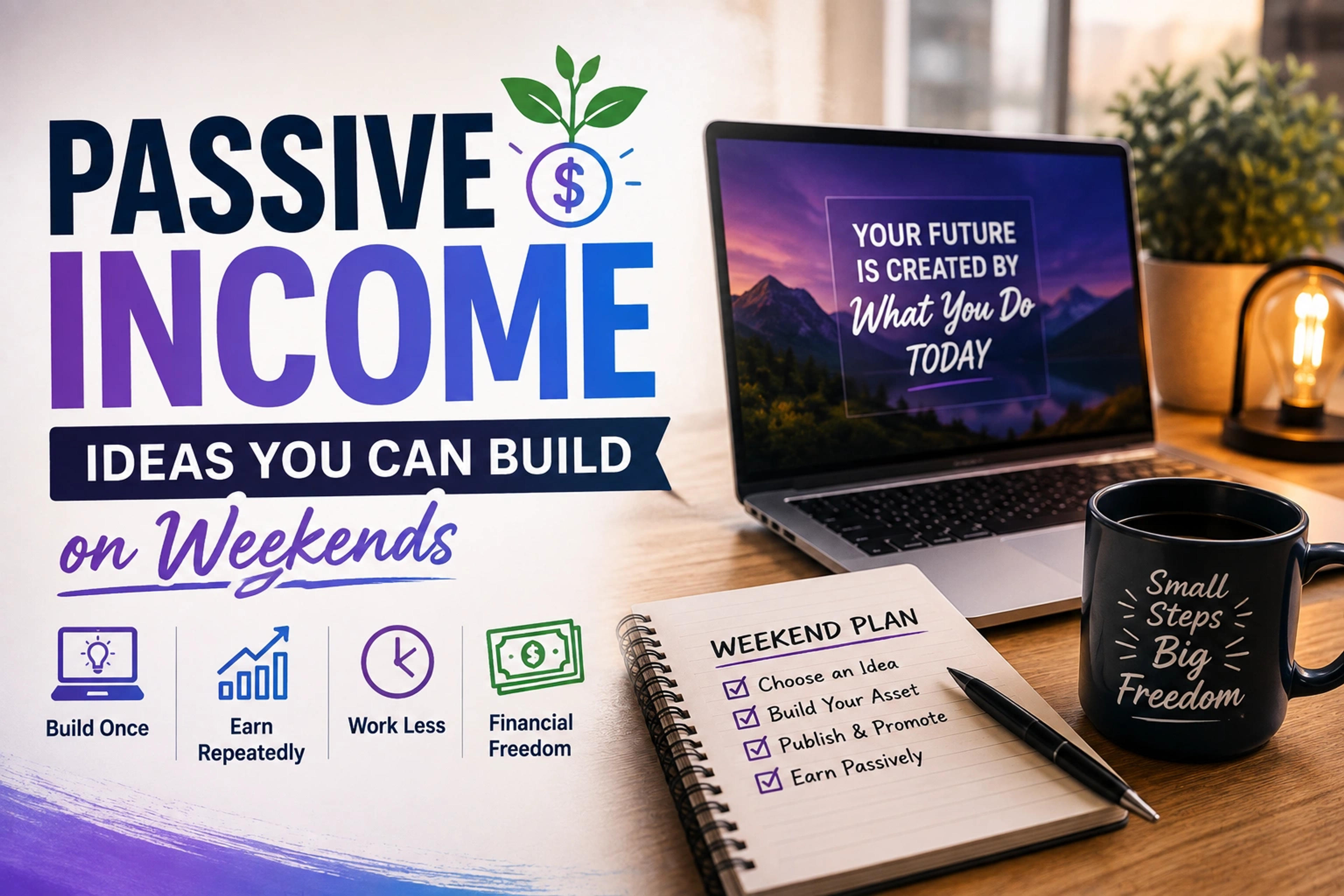
A simple four-weekend plan
You don't need to build everything at once. Try this:
- First weekend: find a problem. Look for a specific problem people already have, and research existing products, questions, complaints and competitors. You want something people actually care about.
- Second weekend: build the first version. Make the smallest useful version of your product. Don't aim for perfect; aim for useful.
- Third weekend: improve and package it. Fix problems, improve the design, write instructions, make product images, set a price and put together a simple sales page.
- Fourth weekend: publish and test. Put it in front of potential customers, share useful content about the problem, ask for feedback and watch what people respond to. Then improve the product based on what you learn.
What to avoid
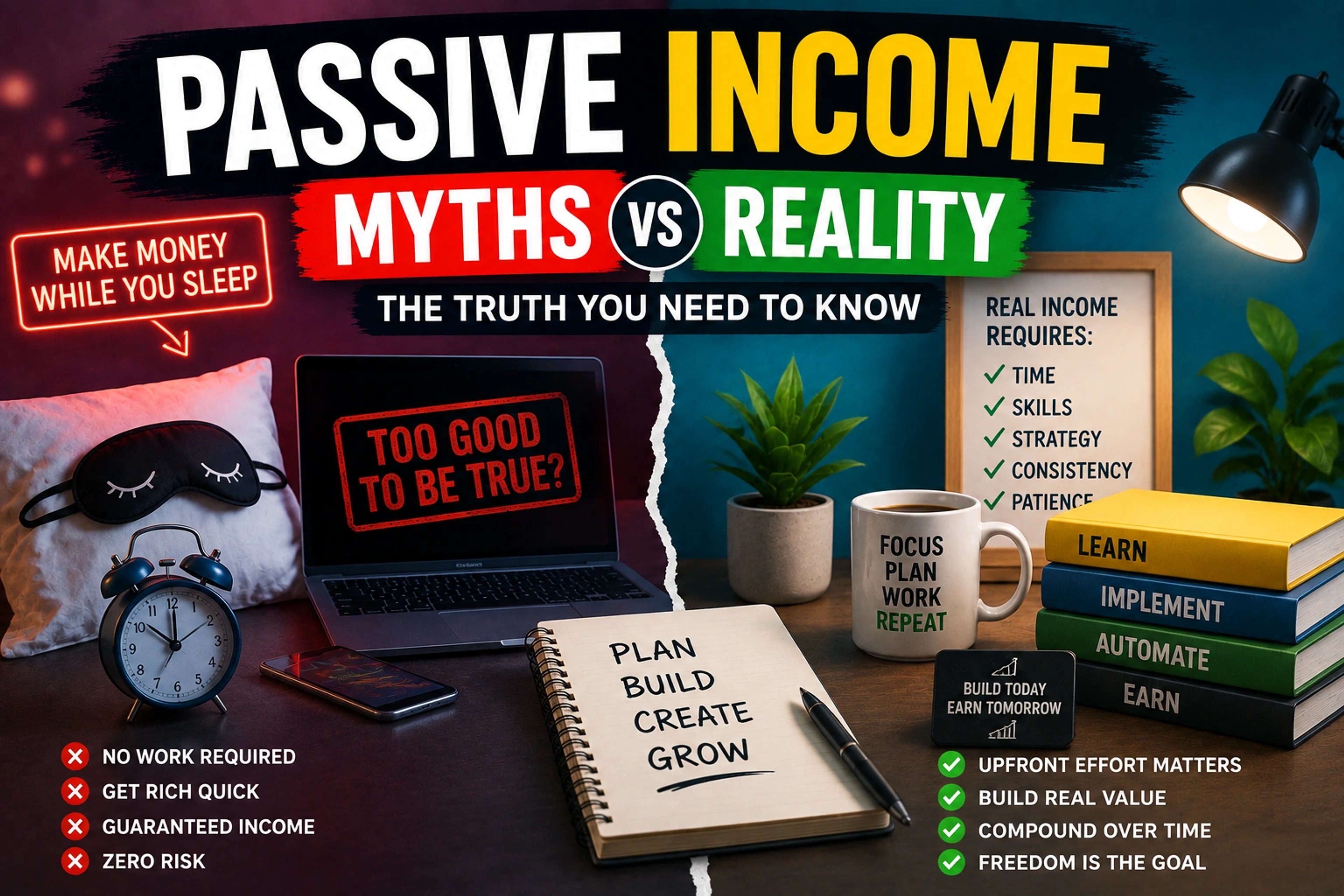
The passive income world is full of unrealistic promises. Be wary of anyone claiming:
- "Make $10,000 this weekend."
- "No work required."
- "Guaranteed passive income."
- "Copy this exact system."
- "Buy my secret method."
Building an income-producing asset usually takes time, testing and repeated improvement. If someone promises effortless wealth, the thing they're really selling may be their course.
Passive income vs active side hustles
| Active Side Hustle | Passive/Low-Maintenance Asset |
|---|---|
| Freelance writing | Ebook |
| Tutoring | Online course |
| Dog walking | Digital template |
| Video editing | Stock footage |
| Consulting | Software tool |
| Delivery driving | Affiliate content |
Active work earns money faster. Passive assets usually take longer to build but can earn without you trading every dollar for another hour. A sensible strategy uses both: active income for cash now, while you gradually build assets that may earn later.
Key takeaways
- Passive income usually takes significant work upfront.
- Digital products are among the easiest assets to build at weekends.
- Blogs, YouTube channels and affiliate content can become long-term sources of traffic.
- Software and online courses have more potential but need more expertise.
- Check that people actually want something before you build it.
- Start with one idea rather than five projects at once.
- Focus on an asset that solves a real problem.
- Expect gradual progress, not instant passive income.
Final thoughts
You don't need a big business to start building passive income. You need an asset: a template, an ebook, a course, an article, a video, a software tool, a photograph or a collection of useful resources.
Your first weekend probably won't produce meaningful passive income, and that's fine. The aim is to make something useful, put it in front of potential customers, learn what works and keep improving it. Spend a few focused hours every weekend building instead of reading about passive income, and you'll eventually have something that earns when you aren't working on it. Start small, build one useful thing, then build the next.