Passive Income Ideas With Low Maintenance
Explore realistic low-maintenance passive income ideas that can continue generating revenue without requiring your attention every day.

Key takeaway
Explore realistic low-maintenance passive income ideas that can continue generating revenue without requiring your attention every day.
Some links are affiliate links. If you sign up we may earn a commission at no extra cost to you. See our disclosure. This is educational content, not financial advice.
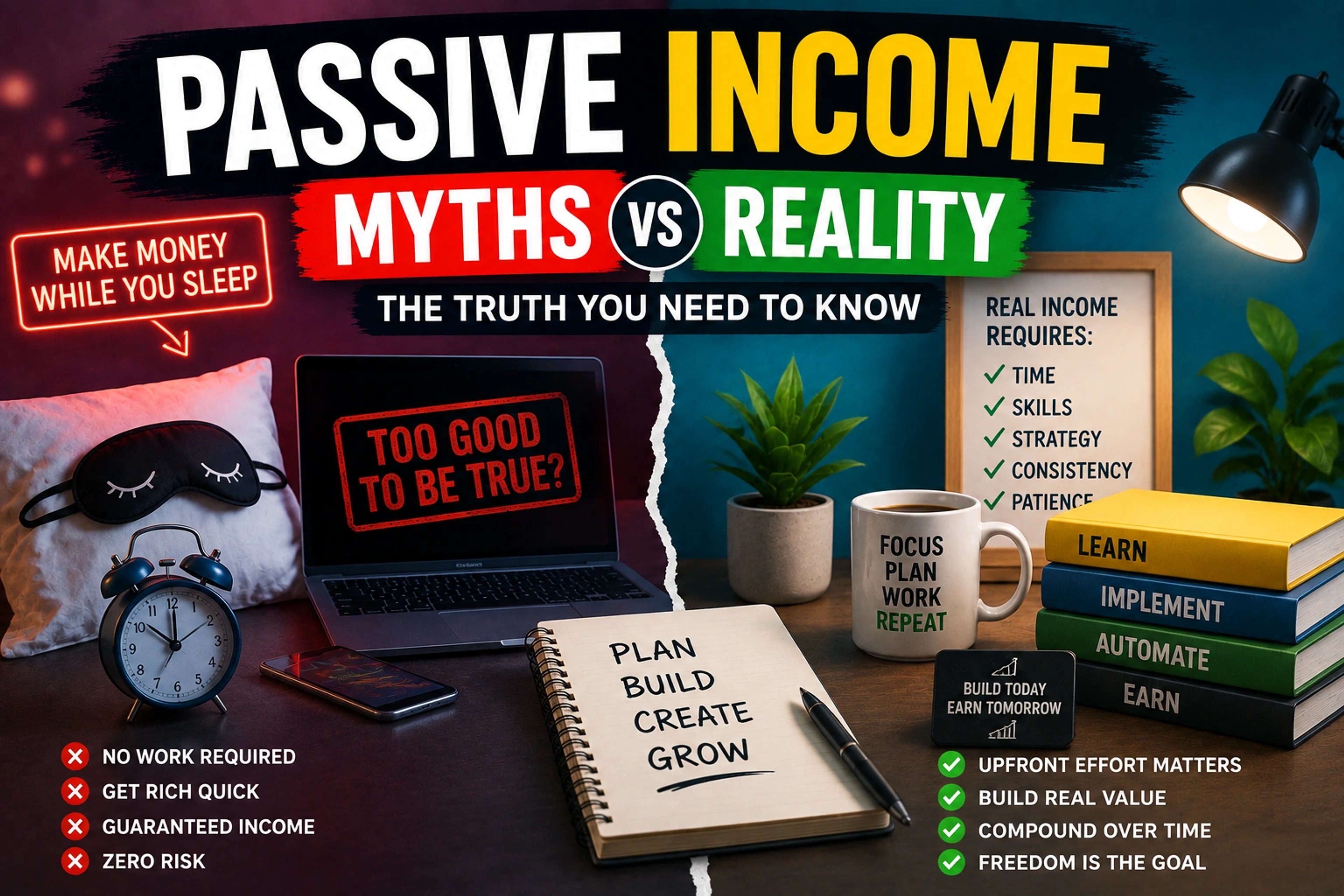
Passive income is often described as money you make while you sleep. It's an appealing idea, but that isn't really how most of it works. Almost every income stream needs some mix of time, money, skill, maintenance or upfront effort.
A more realistic goal is income that doesn't need your constant attention. If you already have a job or other responsibilities, low-maintenance income streams are attractive because you can build them gradually without creating a second full-time job.
Here are some options worth considering.
1. Digital products
You make a digital product once and sell it repeatedly. Examples include:
- Templates
- Checklists
- Spreadsheets
- Guides
- Printable resources
- Design assets
- Small digital tools
Making it can take a lot of work, but delivery can be automated: a customer pays, receives the file automatically, and you never package or ship anything.
After it's finished, the ongoing work is mostly occasional updates, customer support and marketing. Choose a product that won't go out of date quickly.
2. A niche website
A useful website can keep attracting visitors from search engines long after an article is published. You can earn from that traffic through:
- Advertising
- Affiliate partnerships
- Digital products
- Lead generation
- Sponsorships
A website isn't completely passive. Articles need updating now and then, technical problems need fixing and search rankings change. Compared with hourly freelance work, though, it can keep producing results without you working on it every day.
3. Affiliate content
Affiliate marketing becomes fairly low-maintenance when you write useful content about products people are already searching for. A website could publish:
- Product comparisons
- Buying guides
- Tutorials
- Reviews
- "Best tools for..." articles
If someone finds your article through search and makes a qualifying purchase through your affiliate link, you may earn a commission.
The hard part is traffic. Publishing an article doesn't guarantee visitors or sales; it has to answer a real question better than the competing pages.
4. Stock photos and video
If you already make photos or videos, licensing them can add another source of income. You could sell:
- Stock photographs
- Short video clips
- Background footage
- Illustrations
- Audio
- Motion graphics
You do the creative work upfront. Once the files are on the right marketplaces, they can sell without you dealing with each customer. The downside is that building a large library usually takes time.
5. Print-on-demand products
Print-on-demand lets you sell your designs on products without holding any stock. Depending on the platform, products might include:
- T-shirts
- Posters
- Mugs
- Notebooks
- Phone cases
When someone orders, the fulfilment provider can handle production and shipping. Your job becomes making designs, managing listings and promoting the products. It's more hands-off than ecommerce with your own stock, although competition can be fierce.
6. Licensing your work
With licensing, you can earn from the same piece of work more than once. Depending on your skills, you could license:
- Illustrations
- Photography
- Music
- Fonts
- Video footage
- Software
- Educational resources
Instead of selling your time project by project, you let other people use something you've already made under agreed terms. How the licensing works depends on the type of work and the marketplace.
7. A small SaaS product
Software scales well when it solves a narrow problem, and you don't need to build a huge platform. A small tool could do one specific job, such as:
- Generating invoices
- Converting files
- Tracking expenses
- Creating reports
- Managing appointments
- Organising content
Once it's stable, much of the process can be automated. Software isn't maintenance-free, though. You may still have to deal with:
- Bugs
- Security
- Hosting
- Customer support
- Updates
- Changes to third-party APIs
The advantage is that the maintenance can stay small relative to the number of customers using it.
8. A paid resource library
Instead of selling individual products, you can build a library of resources around one topic. A freelancer toolkit, for example, could contain:
- Proposal templates
- Invoice templates
- Pricing calculators
- Client questionnaires
- Project checklists
Customers pay for access to the whole collection. It works best when you can add useful resources occasionally rather than making something completely new every week.
9. Rent out things you already own
Passive income doesn't have to be online. If you own something other people need, renting it out can bring in extra money. Depending on where you live and your circumstances, that could include:
- Parking space
- Storage space
- Equipment
- Specialised tools
- Property
How much work it takes depends heavily on the asset. A parking space may need very little, while a property can involve a lot of management. Always think in terms of net income after maintenance, taxes, insurance, platform fees and other costs.
10. Dividend-paying investments
Investing can produce income without you running a business. Some companies pay part of their profits to shareholders as dividends.
Dividends aren't guaranteed, though. Companies can cut or stop them, and the investment itself can fall in value. If you're considering dividend investing, focus on your overall investment strategy and risk rather than picking something just because its dividend yield is high.
11. Interest on cash savings
For money you need to keep fairly accessible, interest-bearing savings products can earn some income with almost no maintenance. The return depends on:
- Interest rates
- Account type
- Institution
- Country
- Applicable terms
A small balance won't earn much. Still, it's one of the simplest low-maintenance options, because there's little to do once the money is in the right place.
12. A useful YouTube library
YouTube isn't passive in the usual sense, since making videos takes work. Evergreen videos, though, can keep attracting viewers long after you publish them. Tutorials, educational videos, software guides and answers to common questions tend to last longer than content built around current trends.
Older videos can keep bringing in:
- Advertising revenue
- Affiliate commissions
- Product sales
- Leads
- Sponsorship opportunities
The key is making content that stays useful.
What makes an income stream low-maintenance?
Not every passive income idea deserves the label. Five things are worth weighing:
- Upfront work: how much effort it takes before it starts earning.
- Ongoing work: how often you have to maintain it.
- Scalability: whether income can grow without your workload growing at the same rate.
- Risk: how much money you could lose.
- Control: how dependent you are on another platform.
A digital product might take a lot of work upfront and very little fulfilment afterwards. A rental property might bring in regular income but need maintenance and management. A dividend portfolio takes little operational work but carries investment risk. No option is perfect.
Low-maintenance doesn't mean guaranteed
A low-maintenance income stream can still fail. A website can lose traffic, a product can stop selling, a platform can change its rules, an investment can lose value, and a SaaS product can need unexpected work.
So don't look for a passive income idea that's guaranteed. Ask which income stream you could build that fits your skills, your resources and how much risk you can take.
How to make passive income more passive
The biggest gains usually come from automation. For example, a customer finds your product, visits your website, pays online and receives the file automatically. Or a visitor reads your article, clicks an affiliate link and makes a purchase, and the commission is recorded. Or a customer subscribes, the payment renews automatically and the software keeps giving them access.
Every manual step you remove cuts your ongoing workload. Tools for payments, email delivery, scheduling, customer support, analytics and fulfilment can help turn a small business into a more systematic one.
Start with one
A common mistake is trying to build five passive income streams at once. Pick one that matches what you already know. If you write well, consider content or digital products. If you're technical, consider software. If you're creative, consider licensing or digital assets. If you have money to invest, consider suitable investments. If you already own useful assets, look at renting them out. Starting with something familiar shortens the learning curve a lot.
Final thoughts
Low-maintenance income isn't a magic system that produces money without effort. It comes from doing the work upfront and reducing the work needed for each extra sale or payment, whether that's a digital product, evergreen content, software, licensed creative work or invested capital.
The best option depends on what you have most of: time, money, skills or assets. Start with one, build it properly, automate what you can and give it enough time to show whether it works. The aim isn't to avoid work altogether. It's to stop your income depending entirely on how many hours you can put in.