Why Most Budgets Fail
Most budgets fail because they are too restrictive, unrealistic, or difficult to maintain. Learn why budgets break down and how to build a practical spending plan that lasts.
Key takeaway
Most budgets fail because they are too restrictive, unrealistic, or difficult to maintain. Learn why budgets break down and how to build a practical spending plan that lasts.
Some links are affiliate links. If you sign up we may earn a commission at no extra cost to you. See our disclosure. This is educational content, not financial advice.
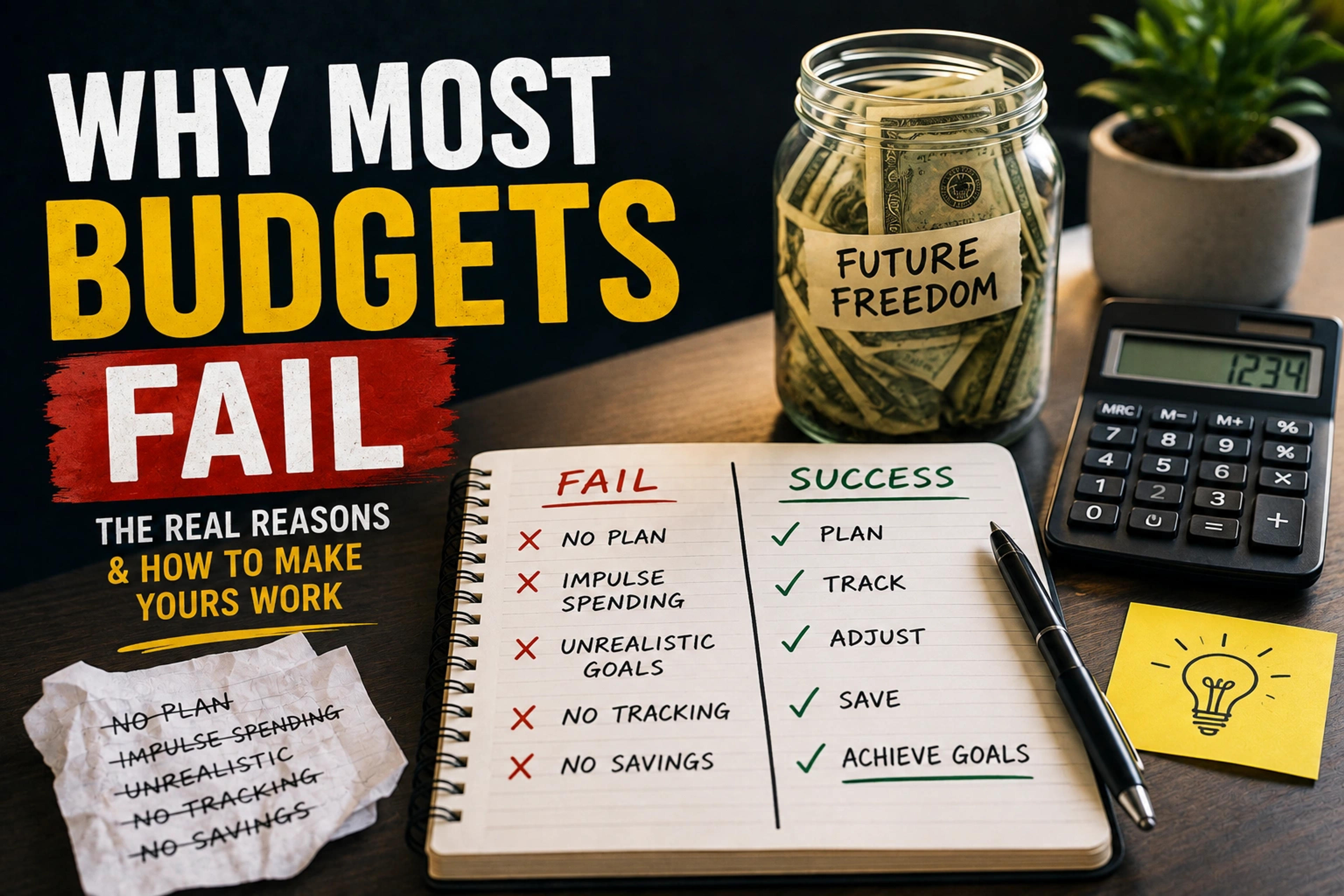
Making a budget sounds simple: add up your income, list your expenses, set spending limits and save what's left. Yet many people make one, follow it for a few days or weeks and then give up.
The cause usually isn't a lack of discipline. More often the budget itself is unrealistic. One that ignores irregular expenses, leaves no room for enjoyment, uses inaccurate estimates or makes you track every tiny purchase is hard to keep up. A good budget shouldn't make your life miserable; it should show you where your money goes, help you decide on purpose and make room for your goals. The Consumer Financial Protection Bureau recommends building a budget from your actual income, spending and bill timing rather than from what you think you should be spending.
Here's why budgets fail, and what to do differently.
1. It's based on what you "should" spend
This is one of the biggest mistakes. Someone earning $4,000 a month decides on $250 for groceries, $50 for eating out, $30 for entertainment and $50 for shopping. On paper it looks excellent. But if they've actually been spending $450 on groceries, $200 eating out, $150 on entertainment and $200 shopping, the budget isn't a plan. It's a wish list.
The CFPB recommends getting an accurate picture of your current spending first instead of writing down the numbers you think you ought to see. Look at the last two or three months of:
- Bank statements
- Credit card statements
- Cash spending
- Digital payments
- Subscriptions
- Bills
Build your budget around that reality. You can bring the numbers down later.
2. You try to cut everything at once
A common plan goes something like: "This month I'll stop eating out, cancel all entertainment, stop shopping, cook every meal and save 30% of my income." It sounds motivated, but it rarely lasts. Changing your whole lifestyle overnight creates a huge gap between your old habits and your new expectations, and eventually you overspend, feel guilty and abandon the whole thing.
Pick one or two changes that will make a real difference, such as:
- Cutting restaurant spending by 25%.
- Cancelling three unused subscriptions.
- Setting a weekly spending limit.
- Automatically transferring a small amount to savings.
Once those feel normal, make the next change. A budget you can keep up is worth far more than an extreme one you follow for two weeks.
3. You forget irregular expenses
This is a big reason a budget can work one month and fall apart the next. Your expenses aren't just rent, utilities, food, transport and entertainment. You may also have:
- Annual insurance
- Car repairs
- Medical costs
- Gifts
- Holidays
- School costs
- Property taxes
- Home maintenance
- Membership renewals
- Festive spending
They don't come every month, but they're still real. The CFPB recommends looking back over several months so you don't overlook less frequent costs like insurance, medical bills, gifts, holidays and seasonal expenses.
The fix is a sinking fund. Instead of letting a $600 annual bill take you by surprise, spread it across the year: $600 ÷ 12 is $50 a month. Put $50 aside each month, and when the bill arrives, the money's already there.
4. Savings are "whatever is left"
Many people budget as income minus expenses equals savings, and often there's not much left. Give savings a place in the budget from the start instead: take your planned spending and your savings out of your income, and what remains is what's available. Saving becomes a deliberate expense rather than an afterthought.
Even if you can't save much right now, starting with a manageable amount builds the habit. The CFPB recommends building regular savings into your budget and notes that saving automatically makes it more consistent.
5. There's no room for fun
A budget that bans spending on anything enjoyable is hard to stick to. You might want to go to a restaurant, see a film, buy something you've wanted, take a weekend trip or meet friends, and if your budget rules all of that out, you'll feel restricted.
Give yourself a "fun money" amount you can spend without guilt, say $100 a month for entertainment. Once it's gone, you wait for next month. The point isn't to cut out enjoyment but to make it deliberate and affordable.
6. You use too many categories
You don't need 40 budget categories. Tracking every possible expense turns budgeting into accounting. You can end up with separate categories for coffee, restaurants, snacks, fast food, delivery, groceries, office lunches and weekend meals, and tracking them all soon gets tiresome. Combine them into one food category and add a few subcategories only if they help you decide better. The aim is better decisions, not the most detailed spreadsheet.
7. You stop tracking after you make the budget
A budget is a plan, not magic. You can build a perfect spreadsheet, but if you never compare it with what you actually spend, you won't know whether you're sticking to it. Consumer.gov recommends using your budget through the month, recording what you spend and comparing it with what you planned.
Try a 10-minute check-in once a week. Ask how much you've spent, which categories are running high, what bills are coming, whether you're still on track and whether anything needs adjusting. That's much easier than trying to reconstruct the whole month afterwards.
8. You ignore cash flow
This catches a lot of people out. You earn $4,000 a month and your expenses are $3,000, so you assume you have $1,000 spare. But the timing can work against you. Rent of $1,500 is due on the 1st, insurance of $300 on the 5th and a $500 card payment on the 10th, while your two paychecks of $2,000 arrive on the 15th and 30th.
You may have enough for the month overall and still run short at certain points. That's a cash flow problem, not necessarily an income problem, and the CFPB recommends paying attention to when money arrives and when bills are due for exactly this reason. Make a simple bill calendar with your income dates, bill due dates and the amounts, so you can see the timing at a glance.
9. There's no room for the unexpected
Sooner or later something comes up: a phone breaks, the car needs work, you need a gift, there's a family event or something at home needs replacing. If every dollar is assigned to a category, one surprise can throw everything off.
Add a small miscellaneous category, say $100 a month. You won't use it every month, and that's fine; whatever's left can roll into savings or another goal.
10. You expect every month to look the same
Real life doesn't work that way. You might spend more around:
- Holidays
- Trips away
- Birthdays
- School enrolment
- Insurance renewals
- Tax season
- Moving
- Car maintenance
Forcing every month into the same pattern makes budgeting more stressful than it needs to be. Your fixed costs may stay steady while your variable costs move around. Aim to keep your overall plan healthy rather than making every category identical each month.
11. You budget your gross income
Your salary isn't necessarily what you have to spend. Taxes, retirement contributions, insurance and other deductions come out before it reaches your bank account, so for everyday budgeting, your take-home pay is usually the right starting point. Consumer.gov defines net income as the amount you receive after taxes and other deductions. Budget with the money you can actually use, and if your take-home pay varies, use a cautious estimate rather than assuming your best month will repeat.
12. You don't budget for debt properly
Debt makes budgeting more complicated. If you have credit card debt, student loans, a car loan or a personal loan, your budget has to cover the required payments before anything else, but making only minimum payments forever can keep expensive debt around for a long time.
It helps to separate the required payments from extra ones, for example $700 required and $200 extra. That shows you what's compulsory and what's part of your strategy. If you have high-interest debt, consider putting extra money toward it while still keeping appropriate savings for your situation.
13. You don't update it when life changes
A budget isn't meant to stay the same forever. Your income, rent, family situation, transport costs, debt, goals, insurance and lifestyle can all change. If you get a raise, move house, get married, change jobs or take on new debt, your old budget may no longer make sense. Update it when your circumstances change rather than waiting until the end of the year.
14. You obsess over small expenses and ignore big ones
Saving $3 on coffee feels productive, but if you're paying hundreds more than you need to on major recurring costs, coffee isn't the real problem. Look at:
- Housing
- Transport
- Insurance
- Debt interest
- Recurring subscriptions
- Major lifestyle costs
Cutting a big expense by $100 a month saves $1,200 a year, which is why your biggest categories deserve the most attention.
15. The system doesn't suit you
Some people love spreadsheets and others hate them; some like apps and others want a simple notebook. You don't need a complicated system. The CFPB notes that people track income and spending in different ways, including tools, journals or going through receipts and accounts. Use the simplest system you'll actually keep using. Consistency matters more than the tool.
A budget is a feedback loop, not a prediction
Many people make a plan at the start of the month and expect reality to follow it. A budget works better as a loop: plan, spend, review, adjust and repeat. Your first budget won't be perfect, and neither will your second, but each month gives you better information about how you really spend.
CFPB research found that many people struggle to use a budget as a real-time guide for spending decisions, and that tracking can feel overwhelming. The answer usually isn't a more complicated budget. It's a system that's easier to use.
How to build a budget that works
- Work out your real income. Start with your take-home pay. If it varies, use a cautious baseline, and don't build your lifestyle around your best month.
- Track your real spending. Go through the last few months of actual transactions rather than guessing, and separate fixed expenses, variable expenses, debt payments, savings and irregular expenses.
- Find your biggest money problems. Don't try to optimise everything. Look at where most of your money goes and which expense you could realistically improve, and start with the biggest opportunities.
- Add irregular expenses as monthly amounts, so your budget reflects the true yearly cost of your life (there's an example below).
- Give savings a specific purpose. Instead of one vague savings category, set separate goals such as an emergency fund, a holiday, a home, a car, education or investing. An emergency fund is especially useful because otherwise unexpected costs can push you onto credit or loans.
- Plan flexible spending: a reasonable amount for entertainment, eating out, shopping and hobbies. The exact figure depends on your income and priorities; what matters is that it's planned.
- Leave a buffer. Don't plan to spend every last dollar; some slack makes the budget more resilient.
- Review weekly. Ten minutes is enough, and you won't discover at the end of the month that your entertainment money ran out in week two.
- Review monthly. Compare what you planned with what you spent, and treat differences as information, not failure. If you planned $400 for groceries and spent $500, find out why. Groceries may genuinely cost more, you may have been counting takeaways as groceries, or the original estimate may just have been unrealistic. Use the answer to improve next month's budget.
Here's how irregular expenses work out as monthly amounts:
| Annual Expense | Annual Cost | Monthly Amount |
|---|---|---|
| Insurance | $600 | $50 |
| Gifts | $360 | $30 |
| Car maintenance | $600 | $50 |
| Vacation | $1,200 | $100 |
A simple budget framework
You don't have to follow any particular budgeting rule. The popular 50/30/20 framework can be a useful starting point, but even the CFPB's educational material notes that rules like it aren't right for everyone. A more flexible approach splits your money into five parts:
- Essentials: what you need to maintain your basic lifestyle, such as housing, food, utilities, transport and insurance.
- Financial goals: emergency savings, debt repayment, retirement, investments and other goals.
- Flexible spending: entertainment, eating out, shopping, hobbies and travel.
- Irregular expenses: money set aside for costs that don't come every month.
- A buffer: a small amount left unassigned for surprises.
That gives you more flexibility than forcing every household into fixed percentages.
What to do when you go over budget
Going over budget doesn't mean your budget has failed. The wrong response is deciding you've already blown it and you'll start again next month. Instead:
- Stop the overspending. If you're over your restaurant budget, cut back on restaurants for the rest of the month.
- Find the cause. Was it an unexpected expense, a bad estimate, impulse spending or a one-off event?
- Move money if you need to. If the expense mattered, take it from a lower-priority category.
- Fix the budget. If the same thing keeps happening, your budget needs to reflect reality.
The 24-hour rule for impulse buys
For non-essential purchases above a certain amount, wait 24 hours, and longer for bigger purchases. In the meantime, ask yourself:
- Do I actually need this?
- Did I plan for it?
- Can I afford it without borrowing?
- Will I still want it next week?
- Is there a cheaper alternative?
- Will it get in the way of an important goal?
You don't have to say no to everything. You're just putting some space between wanting something and buying it.
Three numbers you should know
You don't need to memorise your whole budget, but know your monthly take-home income, what your essential monthly expenses come to, and how much you can safely spend once essentials and goals are covered. Those three numbers give you a quick read on where you stand.
Your monthly budget checklist
Before the month starts:
- Check your expected income.
- List your fixed bills.
- Account for irregular expenses.
- Set your savings goals.
- Set your debt payments.
- Set flexible spending limits.
- Leave a buffer.
During the month:
- Track your spending.
- Check your budget weekly.
- Watch your biggest categories.
- Adjust before you run out of money.
At the end of the month:
- Compare planned and actual spending.
- Note any unexpected expenses.
- Review your savings progress.
- Fix unrealistic categories.
- Prepare next month's plan.
Key takeaways
- Most budgets fail because they don't reflect real life.
- Start with your actual spending, not your ideal spending.
- Plan for irregular and unexpected expenses.
- Don't cut out every enjoyable expense.
- Give savings a specific place in your budget.
- Watch the timing of your cash flow, not just monthly totals.
- Tackle large recurring expenses before worrying about tiny purchases.
- Use a budgeting system you'll actually keep up.
- Review your spending regularly and adjust the plan.
- Going over budget is information, not a reason to quit.
Final thoughts
A budget shouldn't feel like a punishment. It's a way of making decisions. The best budget isn't the one that looks perfect in a spreadsheet; it's the one that still works when your grocery bill comes in higher than expected, your car needs a repair, a friend's birthday comes round, you want to go out for dinner, an annual bill lands or your income changes.
That's why flexibility matters. Start with reality, track what actually happens, plan for irregular expenses, give yourself room to enjoy your money, then review and adjust. Your first budget may well be wrong, and that's normal. A budget gets useful once you stop treating it as a strict set of rules and start treating it as a plan that improves as you learn how you really use your money. You don't need to control every dollar perfectly. You need your money moving toward the life and goals that matter to you.