Compound Interest Explained: The Beginner's Guide to Growing Wealth
Learn how compound interest works, why it's called the eighth wonder of the world, how it's calculated, and how to use it to build long-term wealth.
Key takeaway
Learn how compound interest works, why it's called the eighth wonder of the world, how it's calculated, and how to use it to build long-term wealth.
Some links are affiliate links. If you sign up we may earn a commission at no extra cost to you. See our disclosure. This is educational content, not financial advice.
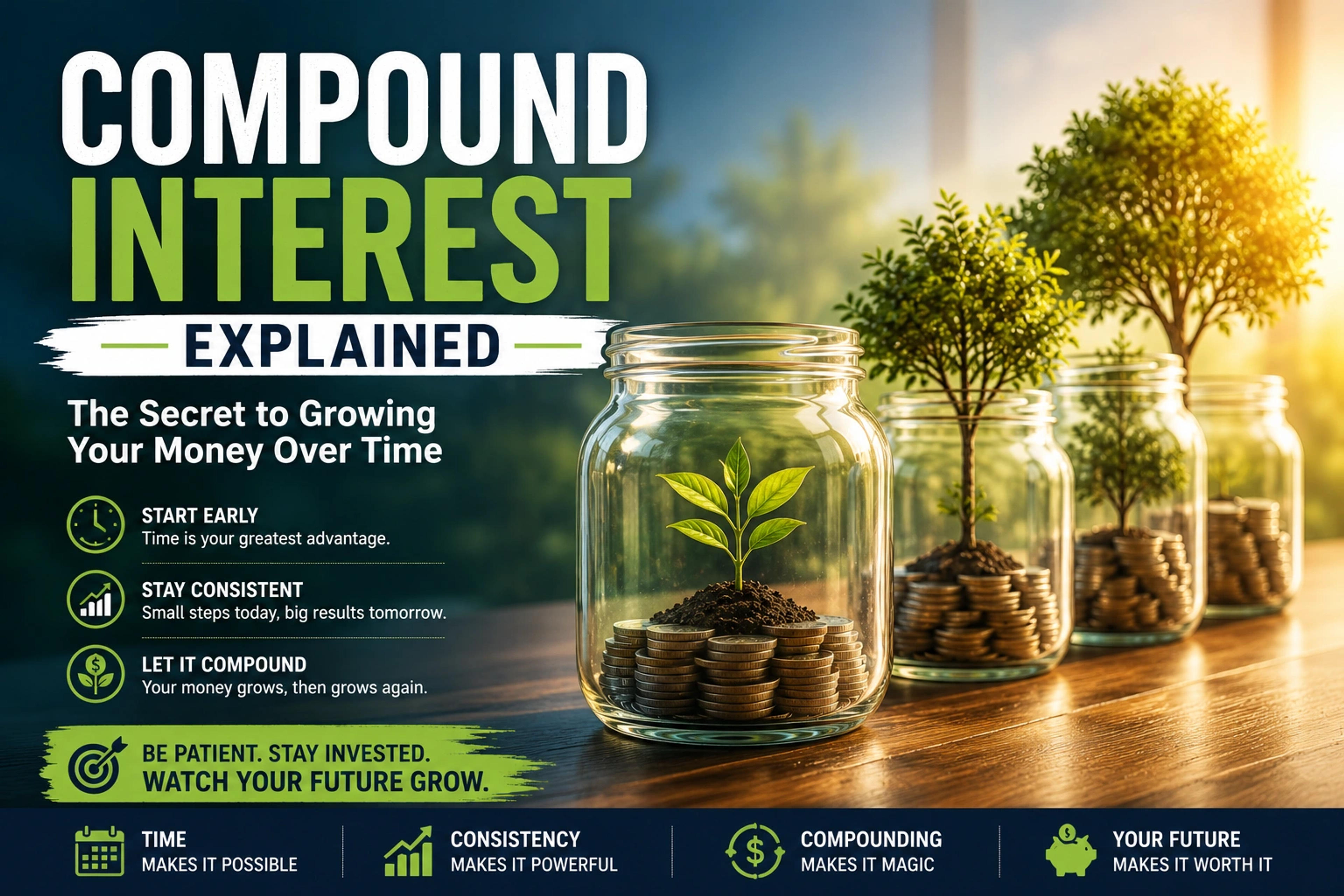
Imagine planting a small tree. In its first year it grows only a little. The next year it grows more, because it's bigger now, and every year after that it gets stronger and taller and puts out more branches than before.
Compound interest works much the same way. Instead of earning returns only on the money you put in, you also earn returns on the interest or gains you've already built up. Over time that snowballs, and your money can grow faster and faster. It's a simple idea that has helped a great many people build wealth through steady saving and long-term investing.
Many beginners underestimate it because growth looks slow in the early years. Its real effect only shows once you've given it enough time. This guide covers what compound interest is, how it differs from simple interest, how it's calculated, why time matters so much and how to use it to grow your own wealth.
Quick answer
Compound interest is interest earned on both:
- The money you originally put in (the principal).
- The interest or returns you've already earned.
Simple interest only pays on the original amount; compound interest lets your money grow on top of earlier growth. The longer your money stays invested, the bigger the effect can be. Compounding rewards patience more than perfection, and starting early often matters more than investing large amounts later in life.
What is compound interest?
Compound interest means earning returns on your original money and on the returns you've already earned, which is why people describe it as interest earning interest.
Say you invest some money and it earns a return in the first year. If you leave both the original amount and the earnings invested, next year's return is calculated on the larger balance rather than just what you started with. Each year the base gets bigger, which is why long-term growth tends to speed up. It's one of the main reasons investors stress starting early and staying invested.
How compound interest works
Picture two identical snowballs. One stays put. The other rolls down a snowy hill, picking up snow as it goes, and because it's getting bigger, it picks up even more with every turn. Eventually it's far larger than the one that never moved.
Your money works the same way: it grows, and then the growth starts producing growth of its own. Over many years, those accumulated gains make up a bigger and bigger share of your total.
See how compounding frequency changes your final balance.
Projected growth
Hover, tap, or use the arrow keys to inspect values for each period.
Final amount
₹2,00,966
Interest earned
₹1,00,966
Year-by-year compound growth
| Period | Principal | Value |
|---|---|---|
| Yr 1 | ₹1,00,000 | ₹1,07,229 |
| Yr 2 | ₹1,00,000 | ₹1,14,981 |
| Yr 3 | ₹1,00,000 | ₹1,23,293 |
| Yr 4 | ₹1,00,000 | ₹1,32,205 |
| Yr 5 | ₹1,00,000 | ₹1,41,763 |
| Yr 6 | ₹1,00,000 | ₹1,52,011 |
| Yr 7 | ₹1,00,000 | ₹1,62,999 |
| Yr 8 | ₹1,00,000 | ₹1,74,783 |
| Yr 9 | ₹1,00,000 | ₹1,87,418 |
| Yr 10 | ₹1,00,000 | ₹2,00,966 |
How this is calculated
A = P × (1 + r/n)ⁿᵗ, where P is the principal, r is the annual rate, n is the number of compounding periods per year, and t is time in years. More frequent compounding grows the balance faster at the same stated rate.
Simple interest vs compound interest
The names sound alike, but the two work very differently.
| Feature | Simple Interest | Compound Interest |
|---|---|---|
| Interest Calculated On | Original principal only | Principal plus previously earned interest |
| Growth Pattern | Linear | Accelerating over time |
| Long-Term Growth | Lower | Higher potential |
| Best For | Short-term borrowing examples | Long-term saving and investing |
| Effect of Time | Limited | Significant |
With simple interest, you earn the same amount each period, because interest is only ever calculated on the original sum. With compound interest, each period builds on the last, so growth speeds up. The difference becomes much more obvious over long periods.
Why compound interest is so powerful
Many people expect investing to produce big gains straight away. Compound growth usually follows a different pattern.
Example: ₹1,00,000 starting amount plus ₹10,000/month at 12% p.a. (historical equity-type returns are never guaranteed).
Early years
Growth looks slow. Your earnings are based on a fairly small balance, so the increases seem modest, and some beginners get discouraged and stop before compounding has had a chance to work.
Middle years
As your balance grows, each year's returns get bigger because they're calculated on a larger amount, and the growth starts to become noticeable.
Later years
Eventually, a large share of your growth may come from earlier gains rather than from what you put in. That's where compounding really shows its strength, and many investors find their portfolio grows faster in the later years than at the start, even while they keep investing the same amount. The first decade lays the foundation; the decades after it are where compounding can make the biggest difference.
The three things that drive compound growth
1. Time
Time is often the most important factor. The longer your money stays invested, the more chances it has to compound. Starting earlier doesn't guarantee higher returns, but it gives compounding longer to work, and even modest amounts can grow a lot when left invested for many years.
2. Rate of return
Higher returns generally make money compound faster, but investments with higher expected returns usually carry more risk. Choose investments that fit your goals and risk tolerance rather than simply chasing the highest possible return.
3. Regular contributions
Compounding gets even more powerful when you keep adding money. Each new contribution gets its own chance to compound, which is why many investors put money in monthly rather than waiting until the end of the year. Consistency often matters more than the occasional large contribution.
Where compound interest works
Compounding isn't limited to one type of product. Depending on the situation, it can happen in:
- Savings accounts.
- Certificates of deposit (CDs).
- Bonds that reinvest interest.
- Dividend reinvestment plans.
- Mutual funds.
- Exchange-traded funds (ETFs).
- Retirement accounts.
- Long-term investment portfolios.
How it works varies between products, but the principle is the same: earnings get the chance to produce more earnings over time.
Why starting early matters
Imagine two people who both want to build long-term wealth. One starts investing in their twenties and the other waits until their thirties. Even if the second person invests more each month, the first may still end up with more, simply because their money had longer to compound.
Time is one of the few advantages you can't get back once it's gone. Waiting for the perfect moment often costs more than starting with a smaller amount today.
Real-life examples
Compounding is easier to understand when you see it at work. These examples are for illustration only; actual investment returns are never guaranteed.
Example 1: saving a fixed amount every month
Emma starts investing at 25 and Noah waits until 35. Both invest the same amount every month and earn the same average annual return. Noah invests for fewer years, so Emma's money has much longer to compound, and by retirement she could have significantly more, even without contributing dramatically more. The lesson isn't that you have to start in your twenties. It's that starting today is usually better than waiting a few more years.
Example 2: a one-off investment
Say you receive a cash gift and invest it instead of spending it. If you leave it alone for many years, the returns it earns can start earning returns of their own, and over time more of the growth comes from earlier gains than from the original amount. That's why people call compound interest a snowball effect.
Example 3: regular contributions
Now picture someone who invests a fixed amount every month. Each contribution gets its own chance to compound: the first for the longest, the second for slightly less, the third a little less again. Over many years, those regular amounts add up to substantial growth, which is why consistency often matters more than investing a large sum once. You don't need huge amounts to benefit; steady investing over many years usually matters more than occasional big deposits.
The Rule of 72
One of the simplest ways to estimate how quickly an investment could double is the Rule of 72. Divide 72 by your expected annual return, and the answer is roughly how many years it could take to double.
| Annual Return | Approximate Years to Double |
|---|---|
| 4% | 18 Years |
| 6% | 12 Years |
| 8% | 9 Years |
| 10% | 7.2 Years |
| 12% | 6 Years |
The Rule of 72 is only an estimate and works best for moderate rates of return. It isn't a prediction or guarantee of future performance, but it's a handy way to see how different rates of return affect long-term growth.
How often does interest compound?
Products don't all compound at the same frequency. Common periods include:
- Daily
- Monthly
- Quarterly
- Twice a year
- Annually
In general, more frequent compounding lets earnings start producing more earnings sooner, but the difference between monthly and daily compounding is usually much smaller than beginners expect. Time, regular contributions and your overall rate of return matter far more, and many people worry about compounding frequency while ignoring those.
Compound interest vs inflation
Compound interest grows your money; inflation reduces what it can buy. The two pull in opposite directions. Cash left under a mattress for years stays the same amount, but rising prices can shrink what it buys.
Investing aims to grow your money so it has a better chance of keeping up with or beating inflation over the long term, which is one reason many people invest money meant for long-term goals rather than keeping it all in cash. Investments carry risk, though, and returns are never guaranteed.
Savings accounts vs investments
Compounding happens in both, but the experience is different.
| Savings Accounts | Investments |
|---|---|
| Lower risk | Higher risk |
| Lower expected returns | Higher long-term return potential |
| More predictable growth | Values fluctuate |
| Suitable for emergency savings | Suitable for long-term wealth building |
| Easier access to funds | Depends on the investment |
Savings accounts put stability and easy access first. Investments aim for long-term growth and accept more uncertainty. Both have a place in a healthy financial plan: an emergency fund belongs in a savings account, while retirement savings usually belong in long-term investments.
How to get the most from compound growth
1. Start as early as you can
Time is one of an investor's biggest advantages. Even if you can only invest a small amount today, starting early gives it more years to compound. Waiting for a better time often costs more than starting smaller now.
2. Invest consistently
Rather than investing only when markets look attractive, many long-term investors put money in regularly. Investing monthly builds discipline and gets every contribution compounding. Consistency is often worth more than perfect timing.
3. Reinvest your earnings
Many investments pay out:
- Dividends
- Interest
- Capital gains distributions
Reinvesting them adds them to your investment base and gives them a chance to compound too. Over long periods, reinvesting can make a big difference to total returns.
4. Stay invested
One of the biggest beginner mistakes is interrupting compounding. Buying and selling in reaction to short-term market moves cuts the time your money spends invested; long-term investing gives compound growth more chance to work.
5. Keep costs low
Fees reduce how much of your money stays invested. Small annual fees look trivial, but over decades they add up, because they also shrink future compounding. Before choosing investments, compare:
- Expense ratios
- Account fees
- Trading costs
- Management fees
Lower costs don't automatically make an investment better, but always factor them in.
Mistakes that reduce compound growth
Waiting too long to start
Market swings aren't compounding's biggest enemy. Lost time is. Every year you delay is one less year for your money to grow.
Withdrawing too often
Taking money out interrupts compounding. Where you can, leave long-term investments alone until you need them for their intended purpose.
Expecting overnight results
Compound interest isn't exciting in the first few years. Its strength only becomes clear after many years of consistent investing, so patience is part of the strategy.
Ignoring inflation
Keeping all your long-term savings in cash can erode their buying power over time. A balance of savings and long-term investments can serve different goals.
Chasing unrealistic returns
Higher expected returns usually mean more risk. Rather than hunting for extraordinary returns, build a disciplined, diversified strategy that fits your goals. Compounding works best with patience, consistency and realistic expectations, not frequent trading or trying to get rich quickly.
Common myths about compound interest
Compound interest is one of the most talked-about ideas in personal finance and one of the most misunderstood. Some myths lead people to delay investing or make poor decisions.
Myth 1: You need a lot of money to benefit
Compound interest works the same whether you start with a large amount or a small one. What matters most is:
- Starting early.
- Investing consistently.
- Giving your money enough time to grow.
Even modest monthly contributions can grow a lot over decades, because each one gets a chance to compound. Many successful investors didn't start with large portfolios; they built them gradually.
Myth 2: Compound interest makes you rich quickly
Social media often gives the impression that investing leads to fast wealth. Compounding doesn't work that way. Growth is usually slow at first, and the real acceleration tends to come much later, once your returns are producing returns. People who expect overnight success often give up long before compounding reaches its potential.
Myth 3: Only investments compound
Many people link compound interest only with the stock market, but it can happen in many products, including:
- Savings accounts.
- Certificates of deposit (CDs).
- Bonds that reinvest interest.
- Dividend-paying investments when dividends are reinvested.
- Retirement accounts.
- Mutual funds and ETFs through reinvested earnings.
The growth rates differ, but the principle is the same.
Myth 4: Higher returns always mean better results
A higher expected return doesn't automatically make an investment better, because higher potential returns usually come with higher risk. A disciplined strategy that matches your goals and risk tolerance is generally easier to stick with than constantly chasing the best performer. Successful investing is about staying invested consistently over many years, not finding extraordinary returns every year.
Myth 5: Missing a few years doesn't matter
Time is one of the most valuable parts of compound growth, so waiting several years cuts the time your money has to compound. That doesn't mean it's ever too late to start, only that starting sooner generally gives you more room to grow. The best time to start was when you first could save; the second-best time is today.
When compound interest works best
Compounding is most effective when several good habits work together.
Investing for the long term. Compound growth needs time, and frequent buying and selling interrupts it and often hurts long-term results.
Making regular contributions. Investing every month gives each contribution its own chance to compound, and that habit often matters more than occasional large investments.
Reinvesting earnings. When dividends or interest are reinvested instead of withdrawn, they join your investment base, so future returns are calculated on a bigger balance.
Staying patient when markets move. Markets naturally rise and fall, and temporary declines are part of investing. Selling in every downturn can throw away years of potential growth.
Compound interest checklist
Use this to check whether you're letting compounding work for you:
- I have clear long-term goals. Knowing why you're investing makes it easier to stay committed when markets swing.
- I invest consistently, so more of my money gets the chance to compound.
- I don't withdraw long-term investments unnecessarily, so compounding can keep working.
- I understand the risks of my investments. Compounding doesn't remove investment risk, and knowing what you own helps you stay invested with confidence.
- I review my portfolio without reacting emotionally. Periodic reviews help; constantly changing strategy usually doesn't.
- I think in decades, not months.
Key takeaways
- Compound interest means earning returns on both your original money and your earlier earnings.
- Time is often the most important factor in compound growth.
- Starting early generally gives compounding more room to work.
- Investing regularly strengthens long-term results.
- Reinvesting earnings speeds up growth.
- Patience and consistency usually matter more than trying to time the market.
- Compounding supports long-term wealth building but doesn't remove investment risk.
Final thoughts
Compound interest is often called one of the most powerful ideas in personal finance, and with good reason: it turns time into one of your biggest financial assets. Instead of depending only on how much you put in, your earlier earnings start working alongside your contributions.
It isn't dramatic at first, and many people underestimate it because the early years feel slow. That's simply how compounding works. It builds quietly, year after year and contribution after contribution, until small, consistent decisions grow into something much bigger than most people expect.
You don't need to predict the stock market, find the next great investment or start with a lot of money. You need a long-term mindset, consistent investing habits, patience and the discipline to let time work in your favour. Compound interest doesn't reward people who wait for the perfect opportunity. It rewards those who start, stay consistent and remain invested.
Quick summary
| Topic | Key Insight |
|---|---|
| What Is Compound Interest? | Earnings generated on both your original investment and previous earnings. |
| Biggest Growth Factor | Time. |
| Best Habit | Invest consistently. |
| Biggest Mistake | Waiting too long to start. |
| Works Best For | Long-term investing and saving. |
| Risk | Investment returns are never guaranteed. |