Common Investment Scams to Avoid
Learn how common investment scams work, the warning signs to watch for, and practical steps to verify an investment before you risk your money.
Key takeaway
Learn how common investment scams work, the warning signs to watch for, and practical steps to verify an investment before you risk your money.
Some links are affiliate links. If you sign up we may earn a commission at no extra cost to you. See our disclosure. This is educational content, not financial advice.
Investing can be one of the most effective ways to build long-term wealth. Unfortunately, it also attracts people who want to take your money.
Investment scams have become much more sophisticated. One may not look like an obvious spam email from a stranger; it can arrive through social media, a messaging app, a dating platform, an online ad or even a hacked account belonging to someone you know. Scammers build professional-looking websites, fake investment dashboards, made-up testimonials and convincing explanations of how their "system" works. The trick underneath is usually much simpler: they want you to send money before you've had time to check what you're buying.
The Federal Trade Commission reported more than $7.9 billion in reported losses to investment scams in 2025, with a median reported individual loss of over $10,000. Knowing how these scams work is part of becoming a smarter investor.
The most important rule
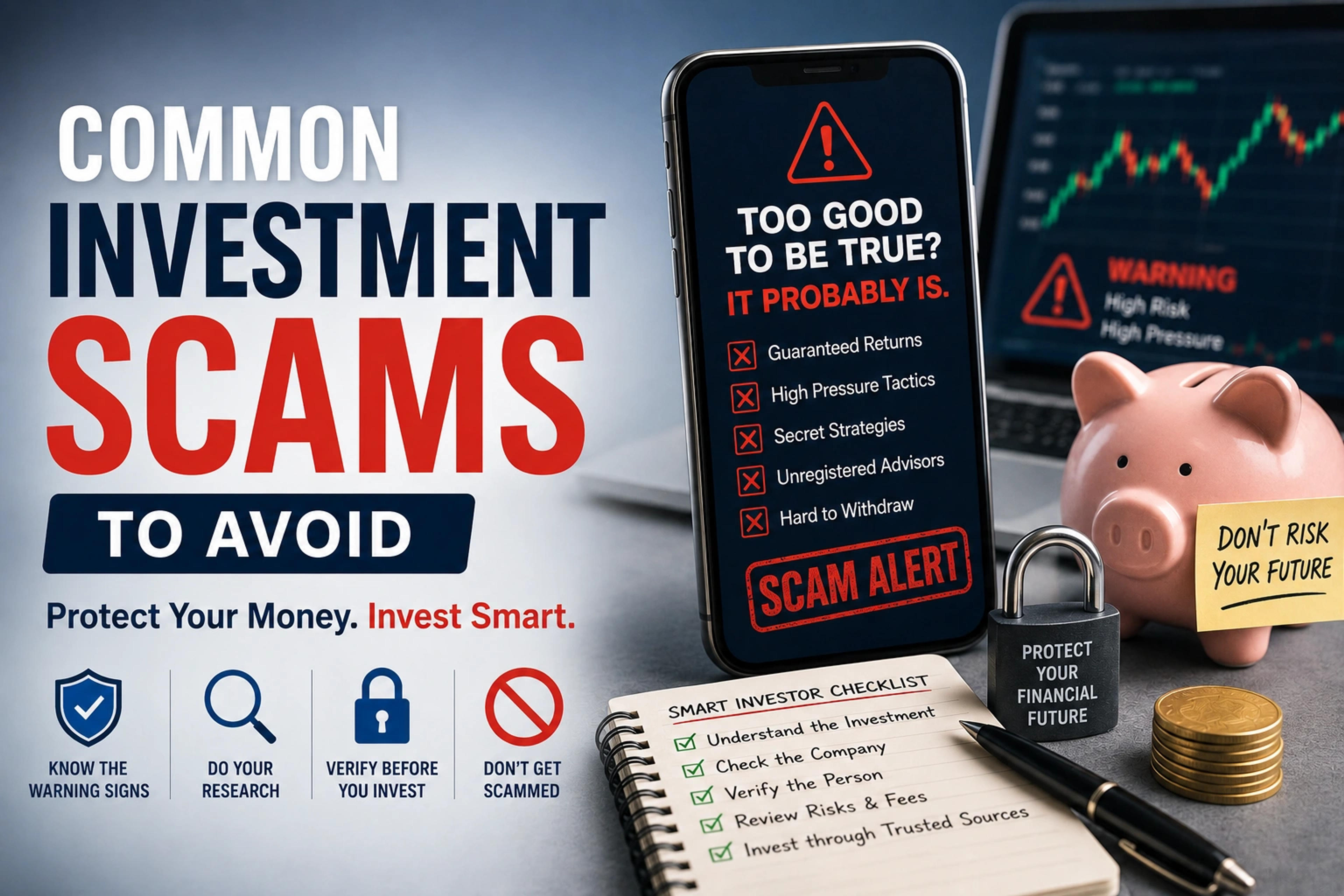
No legitimate investment can guarantee high returns with little or no risk. Every genuine investment carries some risk, and the chance of higher returns generally comes with more of it. If someone promises:
- Guaranteed profits
- Guaranteed monthly income
- "Zero risk"
- Extremely high returns
- A secret strategy that can't lose
- Guaranteed results in a short time
stop and investigate. The SEC and FTC both name guaranteed returns, unusually high profits, low-risk claims and pressure to act quickly as major warning signs.
1. Ponzi schemes
A Ponzi scheme is one of the oldest investment scams, and it still works. The scammer promises attractive returns, but instead of earning real investment profits, they use money from new investors to pay earlier ones. That makes the investment look successful. Investor A puts in $10,000, then Investor B puts in $10,000, and part of B's money is shown to A as a "return."
As long as new money keeps coming in, it can look legitimate. Eventually the flow of new money slows and the scheme collapses. Be suspicious of:
- Consistently high returns
- Little or no apparent risk
- Returns that seem unusually steady
- Difficulty understanding where the profits come from
- Pressure to recruit more investors
- Problems withdrawing money
A Ponzi scheme needs a constant flow of new money because there usually aren't enough real profits to pay what was promised.
2. Pyramid schemes disguised as investments
Pyramid schemes revolve around recruitment. You're told you can make money by investing in a programme and then bringing other people in, and your earnings depend more on recruiting than on selling a real product or earning genuine investment returns.
Be careful if someone tells you your biggest opportunity is bringing five more people into the programme. That's very different from investing in a legitimate business or financial asset. If the model depends mainly on constantly recruiting new participants, investigate very carefully before putting money in.
3. Fake cryptocurrency investment platforms
Crypto scams have become particularly sophisticated. A scammer may show you a professional-looking website or app with an initial investment of $5,000 and a current balance of $8,700. It looks like your money is growing, but the numbers may be entirely fake.
When you try to withdraw, the scammer may demand:
- A withdrawal fee
- A tax payment
- An account activation fee
- A security deposit
- More cryptocurrency
You pay, and the demands keep coming. The balance on screen was never real. The FTC warns that fake crypto platforms can show made-up account growth and then stop victims withdrawing their money.
Never send more money because someone says you need to pay a fee to unlock your investment. Stop and verify the platform independently first.
4. Social media investment scams
Social media has made it very easy for scammers to find victims. An "opportunity" might show up as:
- An Instagram post
- A Facebook ad
- A TikTok video
- A YouTube comment
- A WhatsApp group
- A Telegram channel
- A private message
The pitch might show screenshots of huge profits or a luxury lifestyle. According to its reported-loss data, the FTC says people lost $1.1 billion in 2025 to investment scams that started on social media.
These scams work because social media feels familiar. You might see "My friend invested and made $5,000" or "Thousands of people in this group are already earning." Screenshots, testimonials, follower counts and group sizes don't prove anything, though, and even a friend's account may have been hacked.
5. Romance investment scams
This scam mixes emotional manipulation with a fake investment. Someone you meet online slowly builds a relationship with you. Once you trust them, they mention how well their investments are doing, and eventually they offer to "teach" you. They point you to a particular crypto platform or investment website, you deposit money and the site shows profits, but the scammer controls the money.
The FTC specifically warns against mixing online dating and investment advice. Someone you met on a dating app who asks for money or crypto, or offers to guide your investments, is a major red flag. A person you've only met online should never end up controlling your investment decisions or receiving your money.
6. "Guaranteed" trading systems
Some scams are sold as sophisticated trading systems, with claims like:
- "Our AI predicts the market."
- "Our algorithm never loses."
- "Guaranteed 90% win rate."
- "Our system beats the market every month."
- "You can quit your job."
AI has become part of many fraud pitches. The technology may sound impressive, but impressive language doesn't prove a strategy works. The SEC warns investors to be sceptical of high-return, low-risk claims, including ones dressed up with sophisticated technology or slick materials. Ask whether the claimed performance can be independently verified. If it can't, don't rely on it.
7. Fake investment advisers
Someone may present themselves as:
- A financial adviser
- An investment manager
- A portfolio expert
- A trading professional
- A wealth manager
They may have an impressive website, professional photos, testimonials and a convincing social media presence. None of that proves they're legitimate. In the US, you can use Investor.gov to research investment professionals and check their registration and some disciplinary information.
Before giving anyone your money, check:
- Their real name.
- Their firm.
- Their registration.
- Their disciplinary history.
- How they're paid.
- Where your money will actually be held.
Don't rely only on documents or links from the person you're checking. Find the regulator's website yourself.
8. Fake "insider information"
This one plays on the wish to get an edge. Someone claims to know what's about to happen, perhaps a company announcement, a merger, a government decision, a new technology or a big stock move, and urges you to invest before everyone else finds out. The SEC lists supposed inside information and claims of exclusive opportunities as warning signs to investigate carefully.
If someone really had important confidential information, they wouldn't need to talk strangers online into investing.
9. Fake celebrity endorsements
Scammers may use:
- Celebrity photos
- Deepfake videos
- AI-generated voices
- Fake interviews
- Made-up social media posts
The aim is to make the investment look trustworthy, but a famous face doesn't make an investment legitimate. The FTC specifically warns that celebrity endorsements and testimonials in investment and crypto scams can be faked. Rather than asking who is promoting something, ask whether you can verify the company and the investment independently.
10. Fake investment education programmes
Not every investment scam asks you to invest directly. Some sell expensive "education", promising something like "Our secret system will teach you how to make $10,000 every month." You may get free videos, webinars or seminars first, and then be offered:
- A $1,000 course
- A $5,000 mentorship
- A $20,000 coaching package
Charging for education isn't the problem. Unrealistic income promises and claims that a secret system guarantees success are. The FTC warns that investment training scams often use claims of proven systems, secret strategies and dramatic success stories to sell expensive programmes.
11. Fake real estate investments
Real estate is a legitimate investment, but not every real estate opportunity is. Scammers may promote:
- Fake property developments
- Properties that don't exist
- Made-up rental returns
- Fake crowdfunding opportunities
- "Guaranteed" property investments
A professional-looking presentation doesn't prove ownership, value, financing or expected returns. Before investing, verify:
- The actual property.
- Who owns it.
- The legal entity involved.
- The investment documents.
- The fees.
- How the returns are generated.
- What happens if the project fails.
Never rely entirely on the seller's own promotional material.
12. "Exclusive" investment opportunities
Scammers love exclusivity. "Only five spots remain." "This opportunity isn't available to the general public." The point is to stop you slowing down and doing research. The SEC specifically lists pressure to act immediately and limited-time offers as signs of fraud.
A legitimate opportunity will still be there after a few days of research. If someone says researching will cost you the opportunity, that's a reason to stop, not to hurry.
The 10 biggest red flags
If an opportunity shows several of these, walk away until you've verified it independently:
| Red Flag | Why It Matters |
|---|---|
| Guaranteed returns | Genuine investments carry risk |
| Extremely high returns | May indicate excessive risk or fraud |
| "Zero risk" | No legitimate high-return investment is risk-free |
| Pressure to act immediately | Prevents proper research |
| Secret strategy | Makes independent verification difficult |
| Celebrity endorsement | Can be fabricated |
| Fake testimonials | Social proof can be manufactured |
| Unclear business model | You can't understand where returns come from |
| Difficulty withdrawing money | Strong warning sign |
| Unusual payment methods | Can make recovery difficult |
The FTC and SEC consistently highlight these patterns as major warning signs.
How to verify an investment before sending money
Knowing how scams work is useful, but a verification routine protects you better.
- Stop. Don't transfer money straight away. Give yourself time to think; scammers want emotion to make the decision before logic catches up.
- Understand what you're buying. You should be able to explain it simply: what you're buying, how it makes money, where your money is held, what the risks and fees are, how you withdraw and what happens if it loses money. If you can't get clear answers, don't invest.
- Check the person. If someone is giving you investment advice, independently confirm who they are and, where relevant, that they're registered. Don't use a verification link they send you; find the regulator's website yourself. In the US, Investor.gov has tools for checking investment professionals.
- Research the company. Search for its name together with "scam", "complaint", "fraud" and "review", but don't stop at the search results, because scammers can fake reviews and websites too. Look for independent sources and regulatory information.
- Verify the investment independently. Don't rely on screenshots, testimonials, influencers, Telegram groups, WhatsApp messages, YouTube videos or a salesperson's claims. Find independent documentation.
- Understand how withdrawals work. This matters most with online and crypto investments. Ask whether you can withdraw your money without paying some unexpected extra amount. If you're told you must send more money to release your balance, stop. That's a major warning sign.
What if you've already sent money?
Sending money doesn't mean you have to keep going. If you suspect fraud:
- Stop sending money. Don't pay extra "taxes", "release fees" or "verification fees" just because the scammer says they're required.
- Keep evidence: emails, messages, screenshots, transaction records, wallet addresses, account details, names, phone numbers and website addresses.
- Contact your bank, card issuer or payment service as soon as possible and tell them you believe the transaction was fraud.
- Report the scam. In the US, the FTC takes fraud reports, and investment fraud can also be reported to the SEC.
Don't pay anyone who promises to "recover" your money for an upfront fee. That can be a second scam aimed at people who've already lost money.
A pause-before-you-invest checklist
Before sending money to any unfamiliar investment, ask yourself about the investment:
- Do I understand what I'm buying?
- Can I explain how it makes money?
- Have I checked the company independently?
- Have I checked the person offering it?
- Are the risks clearly explained?
- Are the fees clear?
- Can I verify the claimed returns independently?
And about how it's being sold:
- Am I being pressured to act quickly?
- Am I being promised guaranteed returns?
- Is someone telling me it's a secret opportunity?
- Am I being encouraged to keep it to myself?
- Am I relying on screenshots or testimonials?
If several answers worry you, don't send the money until you've looked into it further.
Why smart people still fall for investment scams
Scams don't succeed because their victims aren't intelligent. They succeed because scammers understand psychology and use:
- Urgency
- Fear of missing out
- Social proof
- Authority
- Trust
- Greed
- Friendship
- Romance
- Fear
- Complicated financial jargon
A financially educated person can still make a bad decision under enough emotional pressure. That's why a process is more reliable than gut instinct.
The golden rule
When someone tells you that you have to act now, your answer should be that you're not investing, then. Good investment decisions don't need panic. Take your time, check the facts and understand the risks, and if you can't tell where the return comes from, don't risk your money finding out.
Key takeaways
- High returns with little or no risk are a major warning sign.
- Don't assume an investment is legitimate because someone you trust recommended it.
- Social media, messaging apps and dating platforms are increasingly used to push investment scams.
- Fake investment websites can display entirely made-up profits.
- Never pay extra money to unlock supposed profits without independently checking the situation.
- Verify investment professionals and companies independently.
- Don't let urgency or fear of missing out replace proper research.
- If something doesn't make sense, don't invest until you understand it.
- If you suspect fraud, stop sending money and keep the evidence.
Final thoughts
The best defence against investment scams isn't knowing every scammer's latest trick. It's the habit of slowing down and checking before you invest. A legitimate investment can stand up to questions: you should be able to understand what you're buying, where your money goes, what risks and fees you're taking on, and how you can get out. If someone won't answer those questions or pushes you to pay before you can check, walk away. You don't need to spot every scam. You only need to avoid handing your money to one.