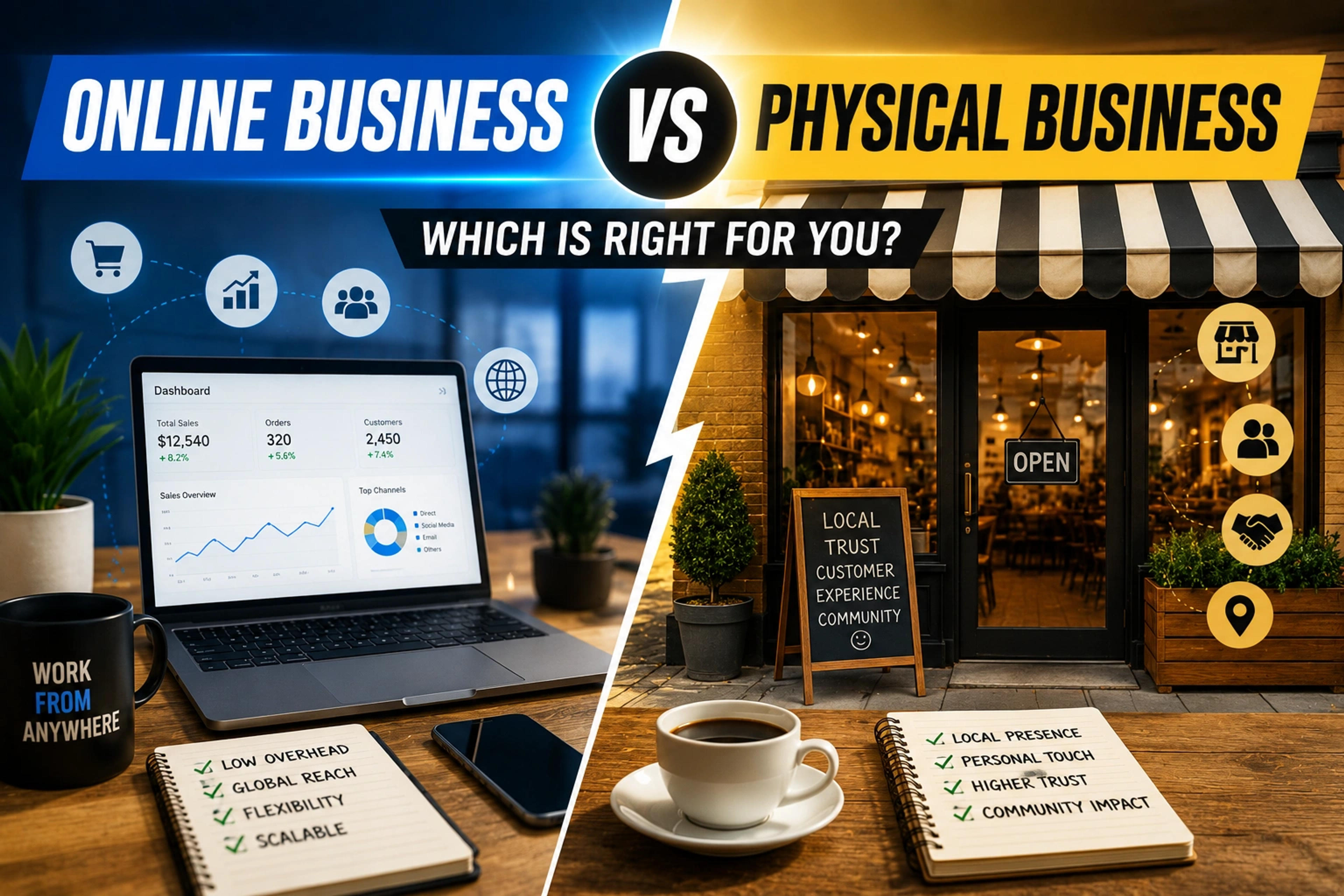
Online Business vs Physical Business
Compare online and physical businesses across startup costs, customers, scalability, flexibility, risks, and profitability to decide which model fits you best.
Key takeaway
Compare online and physical businesses across startup costs, customers, scalability, flexibility, risks, and profitability to decide which model fits you best.
Some links are affiliate links. If you sign up we may earn a commission at no extra cost to you. See our disclosure. This is educational content, not financial advice.
Starting a business today doesn't have to mean renting a shop, hiring staff and buying stock. You could build one from a laptop. Physical businesses aren't outdated, though. Restaurants, shops, repair services, clinics, salons and other local businesses solve problems that can't always be handled online.
So which is better? There's no single answer. It depends on what you're selling, who you're serving, how much capital you have and how you want to run things. Here's how the two compare.
What is an online business?
An online business runs mainly through the internet. Examples include:
- Ecommerce stores
- Software businesses
- Freelancing
- Online consulting
- Digital products
- Online education
- Content businesses
- Affiliate businesses
- Remote agencies
Customers can find it, talk to it and often buy from it without visiting a physical location, which makes it easier to operate across different cities or countries.
What is a physical business?
A physical business depends heavily on a real-world location, equipment, stock or face-to-face service. Examples include:
- Restaurants
- Retail stores
- Salons
- Gyms
- Repair shops
- Medical practices
- Local service businesses
- Manufacturing businesses
Many physical businesses also have an online presence, but the actual service or sale still relies on the physical operation.
The biggest difference: where the value is delivered
The simplest way to tell them apart is to ask where the customer receives the value. If someone downloads your template, uses your software or gets consulting over a video call, you can deliver it online. If someone eats at your restaurant, gets their car repaired or has a haircut, you need a physical operation.
That affects almost everything else, including costs, customers, staffing and how easily you can grow.
Startup costs
This is one of the biggest differences. An online business can sometimes be started with fairly little capital. You may need:
- A website
- Software
- Internet access
- Marketing
- Equipment
- Payment processing
A physical business may need much more money upfront, for things like:
- Rent or property costs
- Renovation
- Equipment
- Stock
- Licences
- Insurance
- Utilities
- Staff
Online doesn't automatically mean cheap, though. An ecommerce company with stock and warehouses can need a lot of capital, and some software businesses spend heavily on development and finding customers. The business model matters more than whether it's online.
Customer reach
Online businesses have a natural advantage when the product can be delivered digitally. Software can have customers all over the world, a digital course doesn't need a classroom for every student, and a freelancer can work with clients in other countries. A physical business usually depends more on its local market; a restaurant needs customers who can get to it.
There's a trade-off. A wider market also means more competition. An online business may reach millions of potential customers and also compete with thousands of businesses chasing the same people. A local business has a smaller market but may face less direct competition nearby.
Scalability
Online businesses often grow more easily when the product doesn't need more physical resources for each extra customer. Serving 100 more software customers may not take 100 more employees, and a digital product can be sold again and again without making another copy.
Physical businesses tend to hit capacity limits more directly. A restaurant has a fixed number of tables, a salon a fixed number of appointments, a local service company a fixed number of workers. That doesn't make them worse businesses; it means growth usually needs more space, equipment, stock or people.
Customer trust
Physical businesses have one useful advantage: customers can see them. Someone can walk in, look at a product, talk to a member of staff and see the operation for themselves.
Online businesses have to build that confidence in other ways, such as:
- Reviews
- Demonstrations
- Testimonials
- Guarantees
- Transparent policies
- Professional websites
- Customer support
- Secure payment systems
For a new online business, earning trust can be one of the hardest early challenges.
Flexibility
Online businesses can be more flexible to run. Depending on the model, you may be able to:
- Work remotely
- Serve customers across time zones
- Operate outside normal business hours
- Automate repetitive work
- Avoid running a customer-facing location
Physical businesses are generally tied to their location and opening hours. Online businesses aren't automatically easy, though. Customer support, technical problems, marketing, fulfilment and product development can still take a lot of time. Being able to work from anywhere doesn't mean you'll work less.
Profit potential
Neither model is automatically more profitable. An online business can have excellent margins, especially when it sells software or digital products, but advertising, software, payment processing, contractors, refunds and the cost of finding customers eat into them. A physical business may have higher running costs and still earn well from products and services people need locally.
Rather than asking which one makes more money, ask which model has economics that make sense for what you want to sell.
Online vs physical business: quick comparison
| Factor | Online Business | Physical Business |
|---|---|---|
| Startup cost | Often lower | Often higher |
| Geographic reach | Potentially global | Usually local or regional |
| Location dependency | Low | High |
| Scalability | Often easier | Usually more resource-dependent |
| Physical overhead | Usually lower | Usually higher |
| Customer interaction | Mostly digital | Often face-to-face |
| Competition | Can be intense | Often locally focused |
| Flexibility | Usually higher | Usually lower |
| Inventory | Model-dependent | Often required |
| Automation | Often easier | Usually more limited |
These are general tendencies, not rules. A large ecommerce operation can have big physical costs, and a small physical service business can run on very little overhead.
What about a hybrid business?
You don't have to choose just one. A hybrid business combines online and physical operations. A local clothing shop could also sell through its website, a fitness studio could run in-person classes and online programmes, a restaurant could take online orders for delivery, and a consultant could meet some clients in person while serving others remotely.
A hybrid can give you the advantages of both, but it adds complexity: you now have to manage several ways for customers to buy and more systems to run.
Which one should you choose?
Consider an online business if:
- Your product can be delivered digitally.
- You want customers beyond your local area.
- You'd prefer lower physical overheads.
- You have useful digital or technical skills.
- You want to be able to work from anywhere.
Consider a physical business if:
- Customers need to be served in person.
- Your product depends on a physical location.
- Local demand is strong.
- Face-to-face contact is an important part of the experience.
- You have the capital and the operational skills to run a physical business.
And consider a hybrid if your customers would benefit from both.
Don't choose based on the trend
"Online business" sounds appealing because of the flexibility, and "physical business" sounds solid because customers can see it. Neither label tells you whether the business will succeed. Start with these questions instead: What problem am I solving? Who has it? How do they solve it today? How much will they pay? What's the most practical way to deliver the solution?
Sometimes the answer will be online, sometimes physical, and sometimes the best opportunity combines both.
Final thoughts
The best business model isn't necessarily the cheapest to start or the one with the biggest audience. It's the one that fits your customer, your product, the economics and your ability to run it well. Online businesses offer reach, flexibility and scalability; physical businesses offer local relationships, experiences people can touch and strong ties to a community.
Start with the customer rather than the format. Instead of asking whether to build an online or physical business, ask what the best way is to deliver something people actually want, and let the answer decide the model.