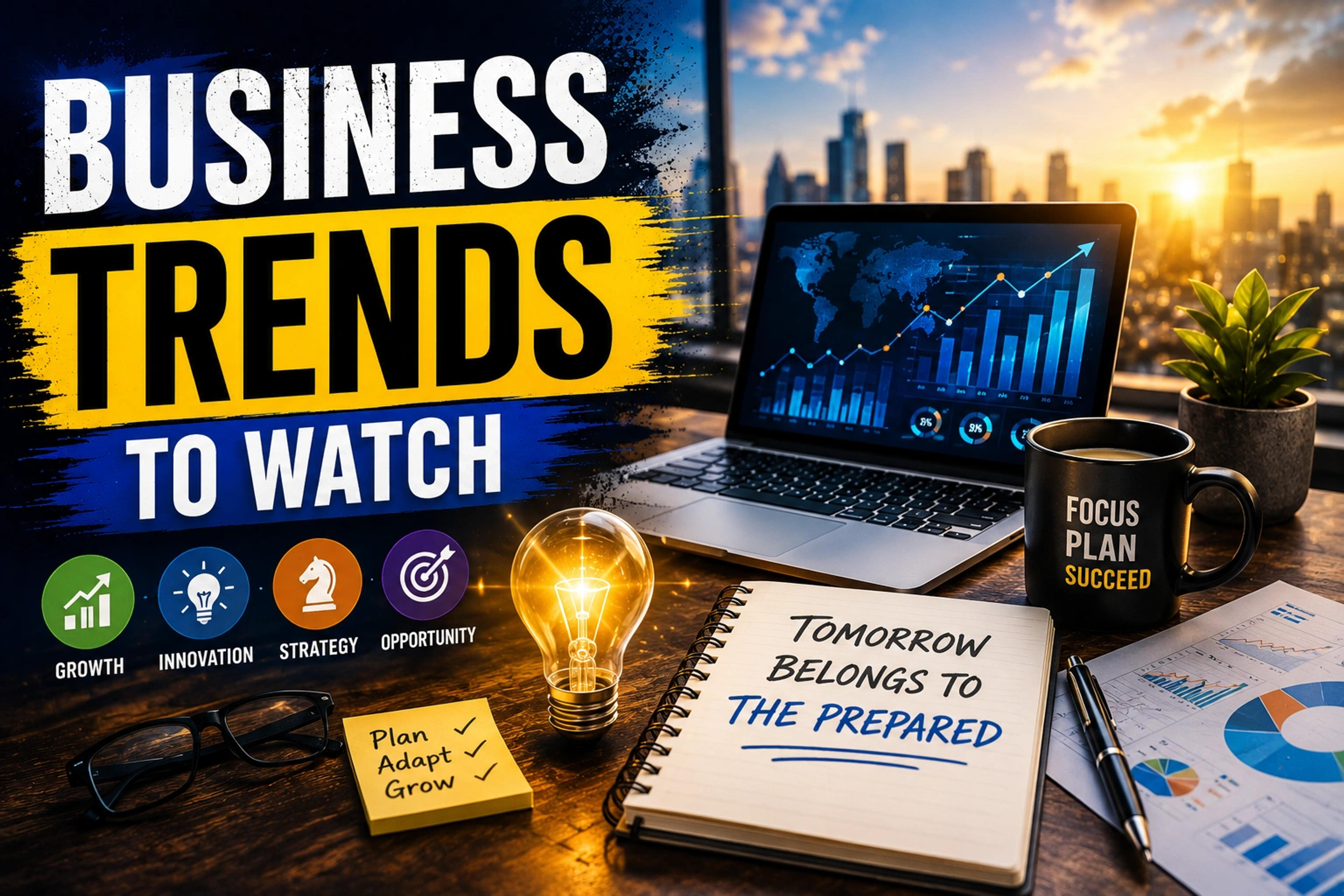
Business Trends to Watch in 2026
Explore the business trends shaping 2026, from AI-powered operations and lean businesses to social commerce, personalization, and changing customer expectations.
Key takeaway
Explore the business trends shaping 2026, from AI-powered operations and lean businesses to social commerce, personalization, and changing customer expectations.
Some links are affiliate links. If you sign up we may earn a commission at no extra cost to you. See our disclosure. This is educational content, not financial advice.
Business trends come and go. Some disappear within months; others change how companies work for years. Knowing what's trending is less useful than knowing which changes create new opportunities and which make existing business models less competitive.
Several developments are worth watching in 2026, from AI becoming part of everyday operations to small teams doing more with technology. Businesses are becoming more flexible, more automated and more focused on the customer. Here are the trends that deserve your attention.
1. AI is becoming part of how businesses run
AI is moving beyond generating content. Businesses increasingly use it for research, customer support, data analysis, marketing, coding, internal knowledge and workflow automation. The bigger shift is that AI is becoming part of how work gets done, instead of a tool someone opens occasionally when they need help. For a small business, that could mean automating tasks that used to take hours by hand.
Rather than asking how you can use AI, ask which part of your business is slow or repetitive for no good reason. That question leads to much more practical uses.
2. Small businesses can operate like bigger companies
Technology has cut the cost of running many business functions. A small team can now get affordable tools for:
- Customer relationship management
- Accounting
- Marketing
- Design
- Analytics
- Customer support
- Automation
- Project management
You still need people, but a small team can do far more than before. A business with three or four people can serve customers in ways that used to take a much larger operation. That lets entrepreneurs compete on speed and specialisation instead of trying to outgrow established companies.
3. More selling happens directly on social platforms
Social media is becoming part of how people buy. A customer might find a product in a video, research it in the comments, ask questions by message and buy it without ever visiting a traditional shop. This matters most for consumer businesses.
Social media works best when it covers the whole path from discovery to trust to conversation to purchase, rather than being one more place to advertise. That makes useful content worth more than promotional posts.
4. Customers expect personalisation
Customers increasingly expect businesses to understand what they want. That doesn't mean sending them more ads. Good personalisation can mean:
- More relevant recommendations
- Faster support
- Better product suggestions
- More useful emails
- Simpler buying
AI and customer data make this easier to do at scale. There's a fine line, though: personalisation should make the experience more useful without making customers feel watched. Businesses that use customer information responsibly can offer better experiences without being intrusive.
5. Trust is a competitive advantage
The internet already holds an enormous amount of content, and AI is adding much more. As customers run into more machine-generated articles, ads, reviews, videos and product descriptions, trust becomes more valuable. Customers want to know:
- Is this company legitimate?
- Are the reviews genuine?
- Is the product actually good?
- Can I reach a real person?
- Does this business keep its promises?
Businesses can stand out by showing they're credible through:
- Real customer experiences
- Transparent policies
- Useful educational content
- Demonstrations
- Expert knowledge
- Consistent service
When there's content everywhere, proof counts for more than volume.
6. Lean businesses are more attractive
You don't need a huge team to build a serious business. Freelancers, automation, cloud software, AI and specialised platforms let entrepreneurs keep their operations lean. This is especially relevant for:
- Solo businesses
- Small agencies
- SaaS products
- Digital businesses
- Specialised consulting
- Online services
Having fewer employees isn't the goal in itself. The goal is keeping the business focused on the work that creates value. A small company with low overheads can sometimes compete well against a larger one with much higher costs.
7. Niche businesses have more room to grow
Selling to everyone is getting harder, and a small business can often compete better by serving one specific group. "Marketing services for businesses" is vague. "Marketing services for independent dental clinics" tells you straight away:
- Who the customers are
- What problems they have
- Where to find them
- What language to use
- What services to offer
Technology lets businesses run profitably at a smaller scale, which makes specialised markets more appealing. You don't always need a huge audience, just the right one.
8. Cybersecurity is no longer just an IT problem
More businesses rely on cloud services, online payments, remote systems, AI tools and digital customer records. That opens up opportunities and also more ways for things to go wrong. A security problem can damage:
- Customer trust
- Business operations
- Revenue
- Reputation
- Sensitive information
Small businesses shouldn't assume they're too small to be targeted. Basic steps such as strong passwords, multi-factor authentication, software updates, access controls and staff awareness make a real difference. As businesses go more digital, security becomes part of running the business rather than something for the IT department alone.
9. Customers are less patient
People are used to fast digital experiences. They expect:
- Quick answers
- Simple checkout
- Easy returns
- Fast websites
- Clear information
- Convenient communication
A complicated process can drive customers away before they buy, so reducing friction is a real advantage. Sometimes the best improvement isn't a new feature but removing three unnecessary steps.
10. Businesses test before they build
One of the most useful changes for entrepreneurs is how cheaply ideas can be tested. Instead of spending months on a product and hoping people want it, businesses can test demand with:
- Landing pages
- Prototypes
- Pre-orders
- Small paid campaigns
- Manual services
- Beta programmes
- Customer interviews
That lowers the cost of being wrong, and a failed experiment is much cheaper than a failed launch.
Which trends matter to you?
You don't need to follow every trend. Ask four questions instead.
Can it reduce my costs? If technology can remove repetitive work, it may improve your margins.
Can it improve my customers' experience? If customers can get what they need faster or more easily, that may give you an edge.
Can it create a new source of revenue? Some trends open up entirely new products, services or markets.
Can competitors use it against me? This one is often overlooked. Sometimes a trend is a threat rather than an opportunity.
Don't chase every trend
A common mistake is adopting something just because everyone is talking about it. Not every trend deserves your money or attention. Before taking on a new technology or strategy, ask what problem it solves, how you'll measure the result, what it will cost and what happens if you don't adopt it. If you can't answer those questions, wait. Being early isn't always an advantage; being right matters more.
Final thoughts
The biggest business trend of 2026 may not be AI, social commerce or personalisation on its own. It's that businesses can move faster with fewer resources. Entrepreneurs can test ideas faster, small teams can automate more work, customers find products through new channels, and businesses can reach very specific audiences without large operations.
That brings opportunity and more competition. The businesses that gain the most will be the ones that spot useful changes early, test them carefully and turn them into something customers value. Watch the trends, but build around real problems rather than hype.